Monday, September 30, 2019

Bailieborough Shortlist

The shortlist for the Bailieborough Poetry Competition has just been announced. The judge was Cavan Writer in Residence, Anthony J Quinn. Congratulations to the shortlisted poets.
The prize giving event and the readings will be held on next Saturday 5 October as part of the Bailieborough Poetry Festival in the Library Arts Space at 2.30pm.
The shortlist in no particular order:
Christopher James - Janus.
Giles Newington - Dynamic Me.
John D Kelly - The Missing Piece.
Orla Fay - The Member of the Wedding.
Ruth Quinlan - Eczema Herpeticum in The Limerick Regional
Eugene Platt - Thank You Note to my New Wife’s Late Husband.
Anne Tannam - I’ll admit to.
Kate Ennals - Drafting a Poem in my Mother’s Old Diary.

Thursday, September 26, 2019

LitLab Anthology - Where You May Find Yourself


It's exciting when a large parcel arrives, especially when that parcel contains the just printed copies of your writers group latest anthology.

This morning copies of Where You May Find Yourself arrived and they look great. The work on this anthology has been going on over the last few months. We submitted poems to Anthony J Quinn, Cavan Writer in Residence who agree to edit the publication. He chose the poems to include, suggested a title and a cover image. There was some agonizing over commas and capitals and last lines but eventually all was agreed and sent to the printer.

The finished product looks great and Anthony has written a most interesting preface. "The LitLab writers, I have to say, are one of the least Keatsian collection of poets you are likely to meet, and I mean that in the best possible way. The poems in this anthology carry the wisdom and good-natured humour of longevity. They concentrate a lifetime of thinking and being." 

"These are poems by mature writers that aren’t an escape into the past but a means of slowing down and re-seeing the present, making this anthology a wonderful counter-balance to the quick thrills of social media and the internet."

This is the fourth anthology of members’ work. Previous anthologies were, Under A Thrupenny Moon, edited by Barbara Smith, in 2013, Between the Lines, edited by Julia Rice O’Dea, in 2015, and Frank Miller Stole my Girl, edited by Noel Monahan, in 2017.

Some of the poems included in this collection were first published in Poetry Ireland Review, The North, Crannóg, Stony Thursday Book and The Cormorant.

Some poems won prizes or were shortlisted in these competitions: Edgeworth Poetry Prize 2018, Padraic Colum Gathering Poetry competition 2018, Ledwidge Society Poetry Prize 2017 and Ilkley Poetry Competition 2017.

The cover photo is of Richard Cyril Duff, a Customs and Excise officer, father of LitLab member Honor Duff, at the Leitrim-Fermanagh border in the late 1920s.

The anthology will be launched at Bailieborough Poetry Festival on Friday 4 October and copies will be on sale there. It will also be possible to buy copies online on the festival site.

Sunday, September 22, 2019

Bray Poetry Competition - The Winner

I'm obviously delighted to have won the Bray Poetry Competition 2019 and to have read the poem at the Culture Night event in Bray on Friday 20 September. Thanks to the organizers who did such a fine job of organisation, notifying those long- and shortlisted and publicizing those and the results. 

Thanks also to the judge, Nessa O'Mahony, for picking out my poem from the more than 200 entered. These competitions are judged anonymously and when entering I replaced two local Sligo placenames  in the original with more generic placenames just in case.

Well done to those on the long and short lists and especially to the other prizewinners, Mark Ward who got second and the joint thirds, Evan Costigan and Catherine Ann Cullen.

I've entered lots of competitions and judged one or two. There are those who talk about a "competition poem", as if a particular style or form is more likely to win. I don't really accept that, having seen the variety of winners in various competitions over the years.

My Bray winning poem was sent out previously twelve times, to competitions and journals and only got longlisted once before. All this means is that it didn't meet the standards of all those other judges which is quite understandable. If you believe a poem is good enough, keep sending it out. I did enter two other poems in the Bray competition and they failed utterly. A special mention of Catherine Anne Cullen who had two poems in the final shortlist of six - quite an achievement!

Having won this competition the poem isn't eligible for most other poetry competitions but is available to submit to journals and magazines as long as it is not published online. Bray have a policy of not publishing winners on their website to allow this.

Bray Literary Festival 2019 takes place next weekend, 27-29 September and the full and varied programme is well worth checking out online.


Wednesday, September 18, 2019

Poetry Competition Anthologies

I've just been reading my copy of What the Peacock Replied, the anthology of the winners and shortlisted poems from the Single Poem category of the Brian Dempsey Memorial Prize 2019, with poems by Dawn Gorman (winner of the Pamphlet Category); Fiona Cartwright (1st Prize); Terry Jones; (2nd Prize); Steven Jackson (3rd Prize) and over 40 other poets.

This competition is an annual event organized by the wonderful Dempsey and Windle team, publishers, poets, event and competition organizers, based in Guilford, UK.

There is an introduction by the judge, Anna Saunders in this case, with general comments and comments on the prizewinning works.

It's most interesting to see the range and variety of the poems chosen. There is no suggestion here that the judge favoured a single style or form of poetry. Poems rhyme or not, are formal or free even experimental, long and short - the shortest a great four line poem by John Bevan. Poems reference popular culture or classical works and authors - Facebook, Barbie, Penelope, Edward Hopper. Some poems even have explanatory subtitles.

My shortlisted poem included in the anthology is The Friary Bell one of those based on the Blackfriary archaeology dig in Trim. Inclusion in the anthology and a free copy was one of the attractions of the competition.

It is important for competition organizers to state clearly in the rules if winning and shortlisted poems are to be published. If they are it rules them out of other competitions and publications. In our Bailieborough Poetry Competition the rules clearly state "The shortlisted poems may be published on the Bailieborough Poetry Festival website" and they usually are.

In the Trim Festival Competition earlier this year we didn't include any such note so when we decided to include the shortlisted poems in the forthcoming Boyne Berries journal we had to ask permission of the authors. I think most agreed. Boyne Berries 26 will be launched on Thursday 3 October.

Next year we intend to state from the start that shortlisted poems will be published in Boyne Berries.

I see the Cathal Bui competition in Belcoo have also published a small anthology of shortlisted poems for their competition, 2019 CATHALBUI POETRY COMPETITION COLLECTION. In this case this wasn't made clear at the beginning so some shortlisted poets aren't included. I had no problem allowing my shortlisted Vertigo at Killadoon to be included.


Sunday, September 15, 2019

Poetry Competitions

I'm lucky to be shortlisted in two poetry competitions at the moment, The Bangor Poetry Competition and the Bray Festival Poetry Competition.

The Bray prize-giving ceremony is on Culture Night, Friday 20th, at 7.30 pm in Bray Town Hall where the three winners will be announced. There are only six poems in the Bray shortlist which makes it even more special having one among them.

The 15 shortlisted poems in the Bangor, Co Down, competition will be on display at The Blackberry Path Art Studios in Bangor Co Down from Thursday 25th September until Sunday 29th September 2019 as part of Aspects Irish Literary Festival and will be voted on by the public during the exhibition.

Winner, runner up and placed poets will be revealed at The Bangor Literary Journal Launch at Fealty’s Back Bar Wed 2nd Oct 7-9 pm.

In both cases shortlisted poets are invited to read at the events. Both these competitions also have good online presences and have publicized the shortlistings and events very well. There are other competitions where entrants struggle to find out if there is a shortlist and who has made the shortlist. This in spite of having paid a not inconsequential entrance fee.

It's always nice to be shortlisted, it means someone has picked out your work from among many many good entries. Having judged a number of poetry competitions, sometimes with others, I realize how much depends on the judges own taste and preferences. So thanks to the judges and organizers in these two competitions and well done to all those shortlisted.

Tuesday, September 10, 2019

Skylight 47 Launch of Issue 12


I attended the launch of Skylight 47 in Galway on Sunday evening. It was a most enjoyable event, a large audience, lots of great readings and tea, coffee and cakes.

This was issue 12 of the newspaper style poetry publication. I was delighted to have a poem accepted for this special issue. For the first time there was a theme - Language, Landscape, and Migration)- and my poem fitted in under language.

The issue also included a supplement with space for unpublished writers, individuals or writing groups based in Galway City or County.

Skylight 47 has always shown an interest in writing groups and published a regular feature on groups from around the country, our group, Boyne Writers, was featured in one issue. This time they worked especially with some groups from Galway city and county as part of their Let the Stories be Told project helped by funding under the Galway 2020 European Capital of Culture Small Towns Big Ideas project. Three such groups got special assistance and facilitator time.

The three editors, Bernie Crawford, Ruth Quinlan and Nicki Griffin, are to be congratulated on their work in planning and carrying out the project and on the finished journal which is a delight to read.

My poem, which I read at the launch, concerns the word "Terminus" which I used when taking grandchildren to the end of the Luas line. An interesting word especially to an older person who has for one reason and another been visiting a number of medical establishments in the past couple of years.

More pictures from the launch on the Facebook page. You can buy the issue on the Skylight 47 site here.

Wednesday, September 4, 2019

Bailieborough Poetry Festival 2019

Bailieborough Poetry Festival takes place on the weekend of October 3 – 5, 2019.

Bailieborough Poetry Competition closing date is this Friday, 6 September. Details here.

Thursday 3 October will see the official opening at 7pm in Bailieborough Library of the festival and of the collaboration between LitLab writers and Virginia artist Jim McPartlin.

On Friday 4 October LitLab's latest poetry anthology will be launched. This is edited by current Cavan Writer in Residence, Anthony J Quinn. The featured poet will be Moya Cannon.

Saturday morning has two poetry workshops, by Pat Boran and Moya Cannon. Booking online.

In the afternoon Anthony J Quinn, this years judge, will announce the winners of the Bailieborough Poetry Competition and shortlisted poets will read. This will be followed by a reading from his published work by Anthony and, after a short break, a talk on developing oneself as a writer also by Anthony.

The Festival concludes on Saturday evening with readings by Kate Ennals and Pat Boran followed by an Open Mic and some music.

Full details on website at present or very soon.

Friday, August 30, 2019

The Caiplie Caves by Karen Solie


What I'm reading at the moment - The Caiplie Caves by Karen Solie (Picador)
 
In her fifth collection, Canadian poet Karen Solie uses as a theme the Caiplie Caves on the shore of the Firth of Forth in Scotland. In poems which flit between modern times and her exploration of the area and the chaos between the fall of Rome and the emergence of modern Europe, she contemplates life, grief, confusion, faith, among the realities of war and power.

The poems are written in Solie’s own voice and also in the voice of St Ethernan, the seventh-century Irish missionary to Scotland who retreated to these caves to decide whether to establish a priory on nearby May Island or pursue a life of solitude, a choice between the active and the contemplative life.

One of the many attractions and delights of the collection is the use it makes of found material, early and modern Christian texts, natural history books, Hegel, St Augustine, Barthes, even The Invertebrate Fauna of the Firth of Forth, 1881, by George Leslie and William A Herdman.

This makes for a glorious mix of language and tone, with a refreshing breadth of vision and reference. I saw Karen Solie read at the Cork International Poetry Festival a couple of years ago and was impressed.

from The Desert Fathers

With or without a bindle of crystal meth,
they made their anchorage in Egypt’s
Wadi El Natrun, or the dismantled
Marine Corps training base of Slab City, California,
hard skills in transition, taking losses
and burning, if not with a sensible fire,
in the pride of specialized knowledge.
Snakeman relocates the red diamond rattlesnake
and northern Mojave rattlesnake
from residents’ trailers to his own to live
alongside him with the scorpions and guard dogs;
it’s tough to have riches and not love them.
St. Anthony sold his land, gave the money to
the poor, yet in his Outer Mountain sanctuary cried
I desire peace, but these bad thoughts
will not leave me.

It’s interesting to compare a version of this poem published online in The Walrus with the version published in the book – lots of changes in line breaks and some deletions.

I’m particularly interested in her use of found material because my next collection, to be published 2020 I hope will contain a number of “found” poems. It can be difficult to know exactly how to attribute various borrowings. Solie does this by the inclusion of comprehensive “Notes” at the back of the book. It seems to works well and doesn’t break the flow of the text but I did find myself checking now and then to see if a line or stanza were borrowed and from where.

Wednesday, August 28, 2019

August At The Edge Cavan

At the Edge is a regular reading series organised by Kate Ennals with assistance from Cavan Arts Office. It is held in Cavan Library on Tuesday evenings at 6.30. 

It has build up a dedicated and knowledable audience many of whom also participate in the Open Mic which follows the readings.
There are usually two or three featured readers, well-know poets or prose writers, and the list of those who have read there is impressive.
Last evening, 27 August the new season started with a well-attended and most enjoyable event featuring four writers. Kate Ennals, the organiser, introduced the readers as "neighbours" coming as they did from neighbouring counties.
The writers were Glen Wilson, Jackie Gorman, Anthony J Quinn and Jessamine O’Connor, poets apart from crime writer Anthony who confessed to really wanting to be a poet. His crime writing does have a lyrical touch about it, in spite of the dark deeds he narrates.
The poetry was great, as was the delivery and the audience really appreciated the variety of subject matter and tone. Well done to all concerned!

Keep an eye on Kate Ennals Facebook page for details of the next reading.


Monday, August 19, 2019

Belfast City Hall - Windows

My first visit to Belfast City Hall last Friday was eyeopening. I was very impressed by the stained glass windows, a wide range of themes and styles.

The centenary window was unveiled in 2006 to celebrate the many successes and achievements witnessed by City Hall during the previous 100 years.

"Included in the window are Titanic and the Harland and Wolff cranes . . . Achievements in the fields of sport, music and literature are also represented and the City Hall mural is represented by the John Luke inspired landscape in which we see a Massey Ferguson tractor and an ‘Electric Hare’ invented by James McKee of OD Cars Ltd. The multicoloured tree reflects the many different traditions and cultures found within Belfast."

More on the windows on the official site.

Designed by Ann Smyth, the window was fabricated and installed by CWS Design in collaboration of Karl Harron. The window was unveiled in 2006.

I was most interested to see the writers honoured in the window, detail below. I love the way Sinead Morrissey and Nick Laird are squeezed in at the end of the shelf!

Monday, August 12, 2019

Corran Herald 2019 - The Philosophy of Pat Gallagher

The Ballymote Heritage Weekend saw the launch of issue 52 the annual journal, The Corran Herald" published by the group. This, in over 90 pages, contains academic articles, popular history, photographs, poems and stories.

This journal has been published since 1985 and the group's website has copies of all the issues, except the most recent. There is a wealth of history in these pages.
http://ballymoteheritage.com/corran-previous-issues/

This year I contributed a poem called "The Philosophy of Pat Gallagher". Pat, pictured here, was my great grandfather and was secretary of the local branch of the United Irish League from 1901 until 1915. He contributed short report on club meetings regularly to the Sligo Champion. I took pieces from these reports and created a "found" poem from them.

I don't know if it works as a poem but it does give a flavour of the rhetoric of the times. Brief extract below.

"Each man must pledge himself to do a man’s part.
The people must be prepared for any sacrifice, even
life, any time their privileges and liberties are
  being tampered with.

Any member absenting himself without a satisfactory
explanation will be struck off and a new member put in his place.
We will not readily let down a man who is a consistent
  Nationalist, and his father before him.

He was a loving son and a faithful comrade, as was
shown on last Sunday when sixty-four young
men wearing white sashes carried his remains
to the grave"


The Corran Herald is on sale in shops in Ballymote and in bookshops in Sligo town.

Saturday, August 10, 2019

Ballymote Heritage Weekend

I was delighted to be asked to give a talk at Ballymote Heritage weekend on the August Bank Holiday Monday. My talk on Sligo, especially South Sligo, in 1919 was very well attended and indications were that the audience enjoyed it.

Many people there were related to persons I mentioned in the talk and had information to add to what I knew. This list of contributions to the Dáil Loan published in the Sligo Champion in 1919 before the loan was declared illegal caused an amount of interest.

This was the 30th such weekend organized by the Ballymote Heritage Group and was as successful as all the others. http://ballymoteheritage.com/

The weekend also saw the launch of the annual journal published by the group, "The Corran Herald". This, in over 90 pages, contains academic articles, popular history, photographs, poems and stories.

This journal has been published since 1985 and the group's website has copies of all the issues, except the most recent. There is a wealth of history in these pages.
http://ballymoteheritage.com/corran-previous-issues/

The Corran Herald is on sale in shops in Ballymote and in bookshops in Sligo town.

Thursday, August 8, 2019

The Dogs of Humanity - Colin Dardis

Colin Dardis' latest publication, the chapbook The Dogs of Humanity has just been published by Fly on the Wall Press. The Belfast launch takes place this evening, 8 August, as part of Eastside Arts Festival, in the Eastside Visitors Centre, 402 Newtownards Road, Belfast.

This is an impressive collection for which I was delighted to write a review and provide a short note for the back cover: The voice in these poems is insightful, urgent but compassionate making the collection an enjoyable but unsettling read, with its call for perception, for engagement with the realities of the human condition and the lost souls of the early twentieth first century. - Michael Farry

My full review can be read here on Neon Books.

You can order The Dogs of Humanity online here - print | kindle

The cover is a detail from Brueghel's Studies of Dogs (c.1616).

Sunday, July 28, 2019

Bailieborough Poetry Prize 2019

Bailieborough Poetry Prize 2019 is open.


This year’s judge is Cavan Writer-in-Residence, Anthony J. Quinn. 


Closing date for entries is Friday September 6th 2019.


http://www.bailieboroughpoetry.com/2019-poetry-prize/

Thursday, November 1, 2018

Ilkley Poetry Competition 2018


Group photograph taken at the presentation of awards and readings for the Walter Swan Trust Poetry Competition, Ilkley Literature Festival 2018 with judge Imtiaz Dharker.

I was delighted to be commended and invited to read my poem.

Results:
1st Place: Virginia Griem – The Strung Jar
2nd Place: Pamela Scobie – Darren (Year 3)
3rd Place: Isobel Thrilling – The Place

Highly Commended:
Ion Corcos – Making Soup
Michael Farry – Clothes-Lines
Ian Royce Chamberlain – Round the Corner

The poems are available on the Ilkley competition page.

Wednesday, October 17, 2018

Bailieborough Poetry Festival 2018

Another very successful and well-attended poetry festival in Bailieborough, the sixth consecutive celebration of poetry here which opened opened with a collaboration between artist Ruth McDonnell and LitLab writing group. The exhibition and festival were officially opened by Iggy McGovern.


Poets Brendan McCann and Enda Wyley read on Friday night and enthralled the audience. An open mic  followed.

Saturday morning had workshops by Enda Wyley and AnneMarie Ní Churreáin.


The afternoon saw the Irish Writers Centre launch their Poetry master class series. The launch included a reading by Noel Monahan who is one of the tutors.

Then Noel, the Bailieborough Poetry Competition judge, announced the result. Winners were:
1st ‘Shannon of the Eye’ Jane Burn, Co. Durham; 2nd ‘Illuminated Manuscript Trinity College Library 2016’ Glen Wilson, Co. Armagh; 3rd ‘Gently Pulling Two Pieces of Poorly Glued Paper Apart’ Jamie Stedmond, Co Dublin.

The festival concluded on Saturday evening with readings by PJ Kennedy and Annemarie Ní Churreáin which were enjoyed by the large audience in Murtagh's lounge.


Monday, March 12, 2018

My Review of Journeywoman by Carolyne Van Der Meer (Inanna, 2017)


In her valuable and concise preface the author, Carolyne Van Der Meer, advises us that “The word ‘journeyman’ refers to an individual who has completed an apprenticeship and has been fully trained in a trade—but who is not yet a master.” 

Her “journeywoman” then is about the journey made by one woman and by many women, through childhood, womanhood and motherhood, towards mastery, enlightenment, maturity. The fifty poems which comprise this collection, Journeywoman, are snapshots taken on that journey.

The volume is divided into four sections of unequal length. The first section is one of the longest. Manoeuvring  is an unexpectedly delightful title for the section which deals with relationships; with mother, with husband, with son, with others. 

Van Der Meer excels at titles and the first poem is entitled (S)mothering which is a poem in itself. This poem sets the tone for the rest of the collection, with its deceptively simple language, the use of unexpected commonplace phrases, the questioning of herself and of others, and the responses. It ranges over three generations, author, her mother, her child. “So who is real? / the ones we are, / have created, the ones who reappear”

I like how we are gently invited to consider mundane common tasks and ponder possible deeper meanings without any sledgehammer language, any obtrusive signposts of the significant. Consider how in The Sewing Box the replacing of a broken button on a husband’s jacket cuff becomes such an important event and leads to such wonderful details and memories.  And see how the repeated, almost off-hand, phrase, “No one will notice”, becomes so important at the end.

Similarly in Folding the Sheets the details of the process become a sort of advance and retreat country dance which ends with the wonderfully evocative, “fold it crisply / into a perfect square”. We are left to imagine the identity of the other person, the precise relationship.

Van Der Meer is good at knowing how much to tell us and how much trust to put in the reader. She is also good at including detailed descriptions, fooling us sometimes into thinking she is telling us everything. In Windows, Lesson at Masala Cooking School and in Homemade Pasta on New Year’s Eve for instance the great accretion of details still leaves central questions of relationships open to the reader’s probing.

The second section Travelogue is the longest and there are accounts of incidents and thoughts arising from trips to Ireland, Italy, the Netherlands, France, Spain. There are poems which involve literary figures, Oscar Wilde’s stature in Galway and grave in Paris, the Brontes in Yorkshire and in County Down, Antoine de Saint-Exupéry, Calderón de la Barca, Lope de Vega, the portraits of writers in stained glass at the National Library, Dublin, and even Jim Morrison. 

Anyone who visited Yeats’ isolated County Galway tower can appreciate that first line of Visiting Yeats at Thoor Ballylee, “It was as though the world had stopped”.

But the most impressive poems in this section may be the more personal ones, Buying Sandals in Oltrarno, where she gets herself “a pair of handmade / Roman sandals, the kind / in the children’s Bibles / her mother used to read”, and Leather Shop in the Via Francesco Crispi,  where boots or shoes are purchased, “I settle on / burnt sienna you on lime green”. As elsewhere in the collection a raft of details are included but the reader is left to figure out exactly the relationship of the couple or the significance of the incidence.

Have those solid Irish midland towns, Mullingar and Athlone, ever before figured at the start and ending of a poem? I doubt it. In Atonement the enigmatic journey begins “By Mullingar, we were through the worst of it” and ends “you took the exit for Athlone / before I could tell you / where to go”. The hint of “alone” in Athlone is great.

Section three’s stark title, The Cancer Journey, points to a different, traumatic journey. These six poems are a multi-layered meditation of the treatment journey, the drugs and medication, the fear of relapse, a fellow-traveller who did not survive and the scars left behind by the disease and the treatment.

The first poem in this sequence, ABVD, deals directly with the 4-drug combination used in the chemotherapy treatment by naming each of the drugs and meditating at length upon it, its name, origins, history, effects on the body.

“Vinblastine sin blasts me / my silent joke, never spoken / another colourless poison / first isolated by men called Noble and Beer / names unlike their protégé, found / in a Madagascar periwinkle plant / so pretty and exotic / so nasty and toxic”.

There is no sugar coating here, no poetic softening of the reality. The poem ends with a simple plea: “ABVD me / back to life”.

The final section of eight poems entitled Fellow Travellers has poems about women, some named, some well-known, others not well-known, some anonymous. These include Emily Bronte, Saint Agnes and Lady Bathe who is interred with her husband, Sir Lucas Dillon in Trim, Ireland in a tomb known as “The Tomb of the Jealous Man and Woman”.

There are two poems in this section concerning the issue of Muslims in Canada, particularly Quebec, with reference to the Reasonable Accommodation debate. The first, The Philosophy of Hijab is in the voice of a Muslim female and the second, Prayer on a Train, describes an encounter with a Muslim originally from Iraq, who prays on a train. It ends with a thought: “I realize she is more / sure, praying on a train / in a foreign land / than so many of us at home”.

The collection ends with a four-section meditation on the nun, Jeanne Le Ber, described as North America’s First Recluse who lived in Ville-Marie which later became Montreal. This was as a result of the poet’s retreat in the convent in which the recluse had lived. The silence, the meditation has such an effect on the poet that in the last stanza the poet and the recluse have become one and the ending could apply both to the art and craft work of Jeanne and to the work of the poet: “God willing the images I stitch / will stay”.

So Carolyne Van der Meer’s Journeywoman ends where all journeys end, with the hope that something will remain, some scrap of memory or image or writing to outlast the life.

The book is beautifully produced and edited by the Canadian publishing house, Inanna, whose mission is to publish a multiplicity of voices, particularly fresh new Canadian voices, that speak to the heart and tell truths about the lives of the broad spectrum and endless diversity of Canadian women. This volume certainly fulfils that promise.

The cover is especially striking and features a specially created painting by the Montreal artist, Ariane Côté, also entitled Journeywoman.

Journeywoman can be purchased on the Inanna website here: https://www.inanna.ca/index.php/catalog/journeywoman/
or on Amazon here:

Well done to all concerned.

Michael Farry
March 2018

Wednesday, January 31, 2018

Journeywoman, poems by Carolyne Van Der Meer


Canadian poet, Carolyne Van Der Meer, has just had her poetry collection, Journeywoman, published  by Inanna Publications, Toronto.


Carolyne has been published in many Irish journals including our Boyne Berries and she attended the launch of Boyne Berries 10 while visiting Ireland in 2011. She is the author of Motherlode: A Mosaic of Dutch Wartime Experience, which was published in 2014.

From the publisher's website: Journeywoman, poems by Carolyne Van Der Meer

"Journeywoman is the story in poems of the explicitly female journey made by women through girlhood, motherhood and beyond. The play on the word journeyman is intentional with the notion of completing an apprenticeship and seeking mastery of the trade implicit.

This unique collection explores the stages of womanhood as defined by this author: the waif, the mother and the crone. It invokes the stories of many to describe the process of mastering the craft of being female, with all its inherent complexities.  The journey involves not only the physical alterations a woman undergoes through the changing of stages—the metamorphosing required to achieve mastery—but also true travel, the road embarked upon to achieve enlightenment, the attempt to grasp the intangible, the ethereal, the metaphysical, the disembodied, the sacred."

Wednesday, November 15, 2017

The Age of Glass Review


I'm delighted with this very careful, complimentary and insightful review of my latest collection, The Age of Glass, by Colin Dardis on the Lagan Online website.

The review concludes:

"Usually, it’s easy to spot the filler in a collection, the poems that could have benefited from a good editor, or just shouldn’t have made the cut. There’s none of that here: in each poem, every line speaks to every other line, concrete, essential and assured of its direction and purpose.

Perhaps overall, it is the power of death that is given the most reverence within, its touch seen in others, felt too close. And yet of the call to rage against that dying light, Farry tells us that death is to accepted; the wearing of a crucifix is “gentle on my neck, | the body no extra burden”.

With touches of dark humour, knockout phrases and overwhelming poignancy, Farry has truly delivered a contender for book of the year here, and one hopes that there will be more to follow soon."


Wednesday, September 13, 2017

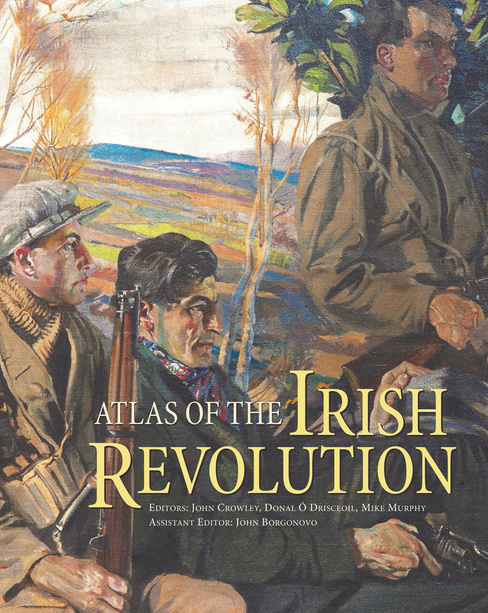
Sligo in the Atlas of the Irish Revolution

I'm delighted to have an article on the War of Independence in County Sligo in the Atlas of the Irish Revolution, just published by Cork University Press.

This is a huge volume of almost 1,000 pages, written by the leading historians, geographers and literary scholars of the Irish revolutionary period.

This work, with its authoritative texts, superb photographs, informative maps and its reproduction of key documents, promises to be the outstanding publication of the ‘decade of commemoration'.

More information here.

To have a look inside the book go here.

A Sunday Business Post review here.