Friday, April 3, 2020

Poetry Ireland Day 2020 - Boyne Berries: The Covid Issue

Boyne Writers Group intends to mark Poetry Ireland Day 2020 in these remarkable times by compiling a special online issue of their magazine Boyne Berries. The magazine will be launched on 30 April 2020 and be available free, as a pdf download only.

Poets are invited to submit one poem only each to the editor, Orla Fay, who will choose in the region of 30 poems for the issue. Poems should adhere to the theme chosen by Poetry Ireland, “There will be time.” More information on their website. 

Poems should be no more than 40 lines long, use Times New Roman 12 and single spacing and be previously unpublished. Please include a short biographical note, which should be 50 words or less. If longer, all text after 50 words will be omitted. 

Submissions should be placed in the body of the email and attached as a word document. Submissions will be accepted until midnight on Sunday 19 April to orla.a.fay@gmail.com only.

Tuesday, March 17, 2020

Michael Farry Reads "Hairdo".

Another poem from the new collection, "Troubles". This is "Hairdo" based on the fact that some women had their hair cut short, "bobbed" during the war of independence, for "crimes" such as being friendly with the enemy. These cutting were inflicted by both sides in the conflict.


Saturday, March 14, 2020

Monday, March 9, 2020

"Troubles" launch postponed.

Please note that due to the current health crisis the launch of "Troubles" has been postponed as has Trim Poetry Festival.


You can purchase a copy by using the PayPal button on the right.

Saturday, February 22, 2020

Troubles Cover


This is the cover of my forthcoming poetry collection, designed by Lotte Bender for Revival Press, Limerick. The photo is used with the permission of The National Library, Dublin.
The soldiers are Provisional Government of Ireland troops in Sligo on Easter Sunday 1922 for the election meeting addressed by Arthur Griffith.
The collection will be launched by poet, Anne Tannam, as part of Trim Poetry Festival, on 14 March 2020.

All invited!

Sunday, February 16, 2020

Trim Poetry Competition Shortlist 2020

Thanks to the 138 poets who entered 345 poems in the 2020 Trim Poetry Competition. Entries came from Ireland, Northern Ireland, Australia, Canada, France, Germany, Switzerland, Wales, UK and USA.

The standard was very high and judging difficult. Finally the two judges, Orla Fay and Michael Farry, have announced the shortlist.

These poems will be included in Boyne Berries 27 to be launched on 13 March 2020 at Trim Poetry Festival and the winner and two runners-up will be announced the following evening.

SHORTLIST (in alphabetical order)

Bearing the Weight of Light by Matt Hohner, USA.
Bird's Eye View by Catherine Conlon, Kildare.
In the Darkroom by John D Kelly, Fermanagh.
Light Rail by David Butler, Wicklow.
Little Snowdrops by Martin Sykes, Mayo.
Mizpah Ring, Man's, circa 1902 by Maria Isakova Bennett, UK.
Nature Lesson by Marian Brannigan, Louth.
Postcard from Symi by Patrick Lodge, UK.
Talking in Pictures by Karen O'Connor, Kerry.
Tree Felling at Lissadell by Maeve McKenna, Sligo.

Friday, February 14, 2020

CATHAL BUI POETRY COMPETITION

CATHALBUI POETRY COMPETITION 2020
                                                                     
Cathal Buí Hedge School – Belcoo, Co Fermanagh

PRIZES:  1st £100: 2nd £60: 3rd £40. Plus a trophy

Winners announced at Cathalbui Hedge  School, Healthy Living Centre (beside the petrol station) Belcoo at 8pm on 12 July 2020

Entry is free – Closing date:  17 March  2020

Send entry to: belcoopoet@gmail.com

RULES
1 Include a name and a land address or country.
2 Place the poem in the body of the email – not an attachment.
3 The judges’ decision is final
4 Winners must be present on 12 July or nominate a delegate to receive the prize
5 State if you don’t want your entry published in the annual anthology.
6  REVISIONS OR NAME CHANGES  -  NOT ALLOWED

Timetable for 12 July Hedge school

3pm: Joyce symposium: Featuring - The Dead, Ulysses and Finnegans Wake.

8pm:   Competition prizes, judges’ comments and readings.

Poetry readings with Noel Monahan, Michael Farry and other poets.

Saturday, February 1, 2020

Molly Courage


This is the figure of Courage from the monument to Daniel O’Connell at the southern end of O’Connell St, Dublin. The monument was designed and sculpted by John Henry Foley and unveiled in 1882. 

The four winged figures at the base, Patriotism, Courage, Eloquence and Fidelity, represent qualities attributed to O’Connell. The bullet hole in Courage’s right breast is said to have been inflicted during the 1916 Rising. 

I imagine her response in a prose poem, in the style of Joyce’s Molly Bloom. Called “Molly Courage”, it was first published in Limerick Writers Centre’s 1916-2016: An Anthology of Reactions

This poem will be included in my next collection, Troubles, to be published by Revival Press, Limerick in March 2020.

Irish poet, Paula Meehan, has written a poem in the voice of the figure of Fidelity from the same O’Connell monument.


Thursday, January 30, 2020

Pat Gallagher


Pat Gallagher (1865-1959) of Creevane, Coolaney, Co Sligo makes an appearance in my new poetry collection which is to be published by Revival Press, Limerick in March.

Pat, my maternal great grandfather, was secretary of Killoran parish United Irish League (UIL) club from 1901 until the club faded away because of the Great War and the postponement of Home Rule around late 1914 or early 1915.

Pat later supported Sinn Féin and spent a short period in Sligo Jail in 1920 having been arrested on suspicion of involvement in a raid for arms on Cultibar House, Coolaney. He hadn’t been involved in the raid but his son, Martin Dan, who was also arrested, had taken part. Pat was a small farmer and a farm labourer and had his hand cut off in an accident with a mowing machine in the early 20s.

I found all his reports on Killoran UIL meetings published in the local newspaper, the Sligo Champion, and used extracts to form a “found poem” arranged roughly in the style of Wittgenstein’s “Tractatus Logico-Philosophicus”. I even found a “silence” quote to match Wittgenstein’s famous last line in the book “What we cannot speak about we must pass over in silence.”

Monday, January 20, 2020

Trim Poetry Festival 2020

Trim Poetry Festival 2020, organized by Boyne Writers Group, will take place on Friday and Saturday,13 and 14 March 2020.

Programme
Friday 13 March: 7.30pm: Launch by Trim writer, Pat Dunne, of Boyne Berries 27 and of Trim Poetry Festival 2020. Readings by contributors.

Tea/Coffee

Reading by Pat Dunne, Trim-born internationally successful crime writer.

Saturday 14 March: 10.00 – 12.30: Poetry Workshop with festival poet in residence, Anne Tannam. Anne Tannam is a Dublin poet with two collections: Tides Shifting Across My Sitting Room Floor (Salmon Poetry 2017) and Take This Life (WordOnTheStreet 2011).

2.30 – 4.30: Anne Tannam individual coaching clinics. These 30 minute sessions will provide support and expert advice around whatever issue or challenge is facing you in your writing practice.

2.30 – 4.30: Readings by local Writers Groups and Open Mic.

5.00 – 6.00: Trim Poetry Competition Results. Winner and runners-up announced.

7.00 – 7.30: Poetry reading by Anne Tannam.

7.30 – 8.00: Tea/Coffee

8.00 – 9.30: Launch of “Troubles” a new poetry collection by Boyne Writers member Michael Farry. Launch by Anne Tannam.

Full details including facilities to book places on Anne Tannam workshop or individual coaching clinic on the festival page here.

Saturday, January 11, 2020

Two Sligo-Meath RIC Deaths

Two RIC deaths I've written about often in my history are these two who have Sligo-Meath connections. It's also nice to have photographs of both.

A poem in the voice of each will be included in my third collection to be published in March this year by Revival Press, Limerick. One of the poems, that on James Gormley, has already been published in The Corran Herald, Issue 49.

Sergeant Patrick Perry was stationed in Cliffony, County Sligo when he was killed with three other RIC men in the Cliffony/Moneygold ambush in north Sligo on 25 September 1920. He was a native of  Coolronan, Ballivor, County Meath.

He had served in Sligo for a number of years, was appointed sergeant in 1909 and was transferred from Bunninadden to Cliffony in May 1913. He was married to Margaret Sharkey from the Boyle area of Roscommon and they had 10 children. Margaret was pregnant at the time of his death. He was buried in his in-laws plot in Killaraght Cemetery in south Sligo.

One of his grandchildren is Colette Mulcahy, formerly Late Late Show production assistant, of "Roll it there, Colette" fame.


James Gormley was one of nine children of Thomas and Ellen from Ballintogher, County Sligo. His father was dead by 1911. James joined the RIC in 1912, aged 21, and served in County Meath at Slane, Enfield and Longwood.

On Friday 28 April 1916 he was among the convoy of RIC sent in motors to Ashbourne where the barracks had been attacked. The convoy was ambushed at Rath Cross, just outside Ashbourne, and James was shot dead.

He was buried in the RIC plot in Navan. His younger brother, also a member of the RIC, attended the requiem Mass. In Ballintogher nearly all the people, including the local Volunteers, turned out to attend a Requiem Mass for the dead constable.


Tuesday, December 24, 2019

Happy Christmas - A Pearse Nativity


This panel, depicting the Nativity, once formed part of a pulpit in St Mary's Church, Athlone. 

The sculptor was James Pearse, father of the Pearse brothers, Patrick and William.

It is now in the Pearse Museum, Rathfarnham.


The New Stable

Once I promised hand-carved figures,
personal, unpolished, to replace those
smiling shop-bought gauds we took out,
stood up, ignored, each Christmas.

I meant it, even thought it out.

Background Joseph in my father’s image,
Mary in mother’s – I can hear her giggle –
wise men the spit of ones we chatted with
on windswept hills in summers years ago.

I was always too busy, too careful.

Too old now, scared of leaving a half set,
a yearly reminder of loss, I made a stable
from memories of those makeshift sheds
which leaned against our houses, long gone.

I worked quickly, planned nothing,

sawed and drilled and fixed for six days,
rough wood for uprights, willow walls,
anxious that it look slipshod, authentic
shelter for animals and passing poor.

I finished it on Christmas Eve,

attached the willow roof, posted a photo
on Facebook but am still unsettled.
I promise next year, if there is a next year,
I’ll carve some figures, shepherds maybe

or a disconcerted donkey.

Michael Farry

Monday, December 16, 2019

Our Lady of Good Counsel Window, Trim


The rose window at the south end of St. Patrick’s Catholic Church, Trim, is being illuminated during Advent and Christmas this year, 2019, making it visible from outside after dark. This window, installed in 1904 just after the church was officially opened, was never fully visible from the inside because of the organ. The parish priest of the time, Fr Michael Woods, and the architect, William Byrne, asked that only the top portion of the window contain stained glass since the rest would be obscured by the organ.

The subject of the window was Our Lady of Good Counsel, a popular devotion at that time as Pope Leo XIII had added that invocation to the litany of the Blessed Virgin Mary on 22 April 1903. The details of this window were being discussed in correspondence between Fr. Woods and Hardman and Co of Birmingham, who had already provided the sanctuary window in the church, from December 1903 and the window was ordered on 27 April 1904. 

While Fr Woods saved money by not including figurative stained glass in the lower part of the window he was anxious that the visible portion be of “very best and richest glass you can make”. He wrote to Hardman “It will occupy the most prominent part of the Church and will be in full view of people as they leave the Church. As the sun will be shining almost the whole day – the window facing due south, the colours will require to be deep and rich.”

The window has the Our Lady of Good Counsel image, Mary and the child Jesus, in the centre surrounded by the legend, “Mater boni consilii ora pro nobis”(Our Lady of Good Counsel, Pray for us). Five angels play different musical instruments in panels surrounding the centre. There are two angels in panels beneath this with thuribles paying homage to Our Lady and the tops of the three lights have foliage down to where the curved portion meets the straight vertical sides.

The window was erected in October 1904 at a cost £162. A donor contributed £130 stating that the price demanded by Hardman was excessive and Fr Woods paid the balance.

It seems that when the organ was installed some portions of the window without stained glass were visible and when Hardman’s fixer was installing the St. Bridget window in the church in 1914 stained glass was “introduced into West window to hide portions exposed by organ”.  This stained glass seems to consist of random pieces which don’t fit into the general scheme.

A photograph from the National Library of Ireland (above) shows the organ and the visible sections of the window. However a new organ, by Moser of Germany, installed in 1982 hid almost all the original window from the inside.

Lighting the window from inside is a great idea, allowing the window to be seen as Father Woods, who is buried at the side of the church, wished it to be seen.

Monday, December 2, 2019

Trim Poetry Competition 2020

I'm one of the judges of the Trim Poetry Competition 2020. Orla Fay, editor of Boyne Berries, is my co-judge.

Judging a poetry competition is very interesting, not only seeing the variety of styles and themes of the entries but also seeing how you react to them. I'm always aware of my own possible biases and prejudices. I once awarded a prize in a competition to a poem about the Solstice in spite of my having read more than my fill of poor poems on that theme. It was the exception, an excellent Solstice poem.

When you have a co-judge it's even more interesting. In our case each judge reads all the entries and comes up with a shortlist of 20. It's amazing how different these can be. Then the fun starts, the discussion, the advocacy, the submissions, the wins, until finally an agreed shortlist of ten is produced.

With Glen Wilson, winner of the inaugural Trim Poetry Competition 2019.

I'm looking forward to this year's deliberations so get your entries in! The competition opened on 1 December 2019 and closes on 12 February 2020. Entries are only accepted online by email to this address: trimpoetry@gmail.com. Entry Fee: €5 per poem or €10 for three poems.

Full details, including how to pay, are on the website/blog:

You will find all the rules there. Please follow the rules carefully or else we may not even see your poem. We judge anonymously of course and I make a rule of never asking afterwards to see whose poems I rejected.

The shortlist of ten will be announced towards the end of February 2020, included in Boyne Berries 27 and on the Trim Poetry Festival blog. Shortlisted poets only will be notified by email and invited to read their poems at Trim Poetry Festival, Co. Meath, Ireland, on Saturday afternoon 14 March 2020. The prize for the winner is 500 euro.  Two runners-up will receive 100 euro each.


Sunday, November 24, 2019

Boyne Berries March 2020

Boyne Berries 26Boyne Writers Group has decided to make their journal, Boyne Berrries, an annual publication from issue 27, March 2020. From 2006 until 2019 Boyne Berries was published twice yearly in Spring and Autumn but increases in printing costs and in postage charges has meant that it was has become more difficult to sustain two issues a year.

So we decided to publish one issue a year to coincide with Trim Poetry Festival to be held on 13 & 14 March 2020. The issue will include the ten shortlisted poems from the poetry competition which will open very shortly.

The submission period for Boyne Berries 27 opened on Saturday 23 November 2019 and closes on Wednesday 1 January 2020 at midnight. The full submission details are on the Boyne Berries Blog. 

The main rules are that poems should be no more than 40 lines long while fiction and prose should be no more than 1000 words. A short biographical note should be included and this should be brief, no more than 50 words.

One of the things which really annoys an editor is when in spite of such rules, writers submit much longer biographies. I've even had writers send long bios and suggest that I, the then editor, cut them down to size. No thanks!

Anne Tannam will be the poet in residence for the 2020 Trim Poetry Festival and the Poetry Competition will open on 1 December 2019 and close on 12 January 2020.

Sunday, November 17, 2019

LitLab at Ardee Baroque

Ardee Baroque festival is one of the important early music festivals in Ireland. It has played host to some of the finest Irish and international artists of this genre and had many memorable and thrilling performances. It has, over its fifteen years, built up a loyal audience.

Ardee Baroque returns for its sixteenth year with a programme of some of the most popular and loved works by Handel, Vivaldi, Gluck, Back and even Irish composer Turlough O’Carolan. Whether you’re a seasoned baroque music fan or someone completely new to it, this year’s Festival is tailored to provide entertainment for all.

The festival takes place this weekend, Friday 22 November to Sunday 24 November 2019. Full details of the Festival are available on the Ardee Baroque Festival website

LitLab writing group is delighted to be associated with Ardee Baroque having been invited to read at the festival for the last four years. This year the LitLab reading will be on Saturday 23 November at 2 pm in Ardee Library. We will read from our latest anthology “Where You May Find Yourself”. Entry Free.

Monday, November 11, 2019

Trim Stained Glass

My poem in the Meath Writers Circle 2019 Annual is titled Stained Glass St Patrick's Church Trim and is concerned with the wonderful stained glass windows by three great stained glass manufacturers, Meyer of Munich, Hardman of Birmingham and Earley of Dublin.

The windows were recently cleaned and restored.

This stanza below from the poem refers to the the martyred Blessed Oliver Plunkett, since canonised, by Earley, erected in 1921 at a cost of £76.

The picture is taken from the parish website which has excellent images of many of the windows.

The seventeenth century hangman pauses, noose 
cocked, sensing in the holiday of a heretic’s execution 
years of dragged-out discord, the tables turned,
criminal sainted, his head honoured in a high church. 
Here, aghast at consequences, he hesitates forever. 

Saturday, November 9, 2019

Meath Writers Circle 2019 Magazine


Boyne Writers Group is by no means the only writers group in Trim. The longest established must be the Meath Writers Circle started by the late well-know Trim poet and writer, Tommy Murray. They meet monthly and for the last five years have published an annual magazine.

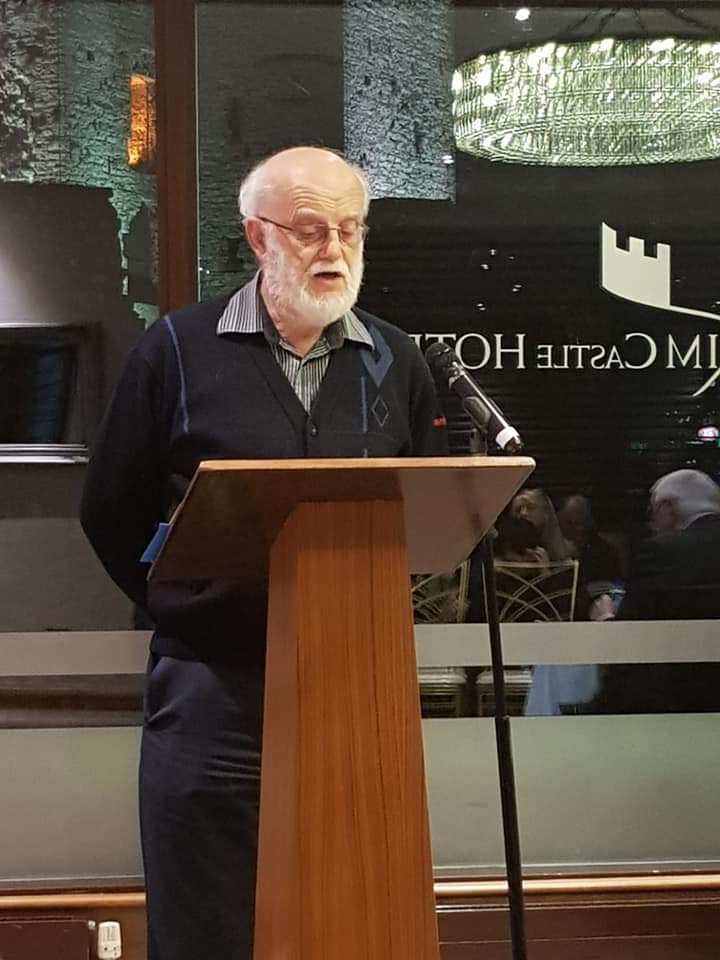
Frances Tallon of the Meath County Library Service launched the 2019 edition of the annual on Thursday 7 November in Trim Castle Hotel.

I was among the large attendance of friends and contributors, many of whom read their poems or stories. As the editor, Frank Murphy, says "The magazine includes both modern and traditional verse with articles on the healing power of music, short stories, pieces that are of historical interest, topical issues, children's poetry, performance poetry, lyrics with video links".

I was delighted to have my poem Stained Glass in St Patrick's Trim included. Others included are Peter Fallon, Tom French and Orla Fay and poems written by James Joyce, John Boyle O'Reilly and Tommy Murray are also included.

With more than sixty pages in A4 format it would make a great Christmas present.


Noel French on "Wolves in Dunboyne"


Eugene Kane reading with chairperson, William G Hodgins, and editor, Frank Murphy, looking on.

Monday, October 28, 2019

WATERFORD POETRY PRIZE 2019


I was delighted that my poem Lecture Near the Ambush Site was awarded third prize in the 2019 Waterford Poetry Prize. I went to Waterford for the presentation on 25 October which was part of the Waterford Writers Weekend/Imagine festival.

The Waterford  Poetry Prize is a little different. It is open to all writers currently living on the island of Ireland, there is no entry fee, and each entrant may submit one poem only. The first prize is €400 plus attendance at a designated writing course at the Molly KeaneWriters Retreat, Ardmore in 2019, second prize is €300 and third is €200. Prize winners also get accommodation in Waterford for the night of the presentation.

The prize has emerged from the influence of the late Waterford writer Seán Dunne whose poetry still continues to inspire.

This year’s judge was Grace Wells who spoke at the presentation about the judging process and the winning poems. I’ve rarely heard more comprehensive and insightful remarks by the judge of a poetry competition. It was clear that Grace spent time with the poems and appreciated the craft and intent of the poet in each case.

The three prize winning poems are quite different in style, form and theme. First prize went to Noel Howley for his poem, Clare Wedding Lore. This has a great opening: Driving West along the old road, into a poem/you said; and then records eight saying with references to time, the weather, relationships, life and death. In one section he imagines a wonderful alliance of Poseidon and the Child of Prague. The poem ends with another great line: At the End of the Land we walked backwards all the way home.

Second prize went to Molly Twomey for her poem, Cassandra. This is a most impressive poem about the current climate crisis, titled for the Trojan prophetess who could foretell the future but nobody would believe her prophecies. What is most impressive is that in twelve lines she creates an apocalyptic vision in the language of pastoral, rural poetry. Gannets will break their necks,/ diving for sardines that no longer exist. She shows, doesn’t preach in spite of using the word preach in the poem.

My own poem, Lecture Near the Ambush Site, is a reflection on writing history about the war of independence period and dealing with tragic incidents, the long lasting effects of which are usually skipped over. How many families grieved for so long over those killed on all sides in that period? Grace Wells said that the poem’s attempt to mix the present and the past was successful and she liked the last line especially: I stopped, could say no more.

Thanks to the judge, Grace Wells, the Waterford Arts Officer, Margaret Organ, and all concerned with the competition and the Waterford Writers Weekend. It was a most enjoyable and worthwhile visit.

Photo Above: Prizewinners Molly, Noel and myself in the front with the Mayor of Waterford. Grace Wells and Arts Officer Margaret Organ behind.


Wednesday, October 23, 2019

Writing Home Anthology

I've just got a copy of this new anthology from Dedalus Press, selected and edited by Pat Boran  and Chiamaka Enyi-Amadi, from an open call which drew hundreds of submissions. Contributors hail from all over the world and most now live in Ireland.

I love the sense of unease which surrounds the volume, the awkwardness as regards titles and themes reflected in its frequent use of quotation marks. The subtitle is The 'New Irish' Poets and the blurb on the website says "Poets from the ‘new Irish communities’, the ‘hyphenated Irish’, the Irish of mixed cultural, linguistic or ethnic origins, are all represented"

Pat Boran in his editorial deals with this, saying sensibly "a little unease is not unusual (or entirely useless) at the start of a journey". He deals especially with the general theme of the anthology, 'home'. Those of us who are internal migrants, if that is the correct term, know exactly how complicated the term 'home' can be.

The fifty poets in this anthology are generally polished practitioners and have histories of publication behind them. The wide range of styles and approaches to the general theme makes it a most entertaining read. The poets come from all over the world, some have English as their native language, others are writing in a second language, only a few poems included are translations.

I like the way the anthology is put together. White space is cut down, poems do not have pages to themselves, poems start at the bottom of pages and continue over, all giving the impression of trying to fit in as many as possible. I also like the fact that some poets have one poem while others have more - I think nine is the record - giving the impression that the poem's the thing.

It's difficult to pick out individual poets but I loved the poems by Polina Cosgrove - "the Russian girl with an Irish surname/ Who was a Russian girl with a Jewish surname/ Who was a Russian girl with a Russian surname/ Who once spent nine months in the belly of/ An Armenian girl with a Russian surname". I especially like Polina's use of repetition in "Say Yes" and "My Name Is".

I like the fact that many of the poems are a little less than positive about the new home Ireland. For instance Bogusia Wardein, a frequent visitor to Ireland, who regards Galway as her "literary home" can still be a sharp critic. Her "From the West Coast" is a sad and humourous look at the Irish from the outsider's eye. "People ask me how I am but don't wait for the answer" "After drinking they mark their territories by spewing here and there". "People call towers castles, hills mountains, and greens parks".

Her "I consider My Home Planet" makes comparisons between a perfect place and Ireland: "For fourthly they say what they mean/ For fifthly they mean what they say" though there is more than a hint that this perfection might actually be less interesting.

Art Ó Súilleabháin, a former work colleague of mine, brought up in Boston, is also here with two poems dealing with outsiders. Art mentions being published in our magazine, Boyne Berries, in his bio which is nice. As editor of Boyne Berries I published poems by another contributor Landa Wo, way back in issues 2 and 4.

All in all a most interesting read, well worth a read. More details on the website.