I'm obviously delighted to have won the Bray Poetry Competition 2019 and to have read the poem at the Culture Night event in Bray on Friday 20 September. Thanks to the organizers who did such a fine job of organisation, notifying those long- and shortlisted and publicizing those and the results.
Thanks also to the judge, Nessa O'Mahony, for picking out my poem from the more than 200 entered. These competitions are judged anonymously and when entering I replaced two local Sligo placenames in the original with more generic placenames just in case.
Well done to those on the long and short lists and especially to the other prizewinners, Mark Ward who got second and the joint thirds, Evan Costigan and Catherine Ann Cullen.
I've entered lots of competitions and judged one or two. There are those who talk about a "competition poem", as if a particular style or form is more likely to win. I don't really accept that, having seen the variety of winners in various competitions over the years.
My Bray winning poem was sent out previously twelve times, to competitions and journals and only got longlisted once before. All this means is that it didn't meet the standards of all those other judges which is quite understandable. If you believe a poem is good enough, keep sending it out. I did enter two other poems in the Bray competition and they failed utterly. A special mention of Catherine Anne Cullen who had two poems in the final shortlist of six - quite an achievement!
Having won this competition the poem isn't eligible for most other poetry competitions but is available to submit to journals and magazines as long as it is not published online. Bray have a policy of not publishing winners on their website to allow this.
Bray Literary Festival 2019 takes place next weekend, 27-29 September and the full and varied programme is well worth checking out online.
Sunday, September 22, 2019
Wednesday, September 18, 2019
Poetry Competition Anthologies
I've just been reading my copy of What the Peacock Replied, the anthology of the winners and shortlisted poems from the Single Poem category of the Brian Dempsey Memorial Prize 2019, with poems by Dawn Gorman (winner of the Pamphlet Category); Fiona Cartwright (1st Prize); Terry Jones; (2nd Prize); Steven Jackson (3rd Prize) and over 40 other poets.This competition is an annual event organized by the wonderful Dempsey and Windle team, publishers, poets, event and competition organizers, based in Guilford, UK.
There is an introduction by the judge, Anna Saunders in this case, with general comments and comments on the prizewinning works.
It's most interesting to see the range and variety of the poems chosen. There is no suggestion here that the judge favoured a single style or form of poetry. Poems rhyme or not, are formal or free even experimental, long and short - the shortest a great four line poem by John Bevan. Poems reference popular culture or classical works and authors - Facebook, Barbie, Penelope, Edward Hopper. Some poems even have explanatory subtitles.
My shortlisted poem included in the anthology is The Friary Bell one of those based on the Blackfriary archaeology dig in Trim. Inclusion in the anthology and a free copy was one of the attractions of the competition.
It is important for competition organizers to state clearly in the rules if winning and shortlisted poems are to be published. If they are it rules them out of other competitions and publications. In our Bailieborough Poetry Competition the rules clearly state "The shortlisted poems may be published on the Bailieborough Poetry Festival website" and they usually are.
In the Trim Festival Competition earlier this year we didn't include any such note so when we decided to include the shortlisted poems in the forthcoming Boyne Berries journal we had to ask permission of the authors. I think most agreed. Boyne Berries 26 will be launched on Thursday 3 October.
Next year we intend to state from the start that shortlisted poems will be published in Boyne Berries.
I see the Cathal Bui competition in Belcoo have also published a small anthology of shortlisted poems for their competition, 2019 CATHALBUI POETRY COMPETITION COLLECTION. In this case this wasn't made clear at the beginning so some shortlisted poets aren't included. I had no problem allowing my shortlisted Vertigo at Killadoon to be included.
Sunday, September 15, 2019
Poetry Competitions
I'm lucky to be shortlisted in two poetry competitions at the moment, The Bangor Poetry Competition and the Bray Festival Poetry Competition.
The Bray prize-giving ceremony is on Culture Night, Friday 20th, at 7.30 pm in Bray Town Hall where the three winners will be announced. There are only six poems in the Bray shortlist which makes it even more special having one among them.
The 15 shortlisted poems in the Bangor, Co Down, competition will be on display at The Blackberry Path Art Studios in Bangor Co Down from Thursday 25th September until Sunday 29th September 2019 as part of Aspects Irish Literary Festival and will be voted on by the public during the exhibition.
Winner, runner up and placed poets will be revealed at The Bangor Literary Journal Launch at Fealty’s Back Bar Wed 2nd Oct 7-9 pm.
In both cases shortlisted poets are invited to read at the events. Both these competitions also have good online presences and have publicized the shortlistings and events very well. There are other competitions where entrants struggle to find out if there is a shortlist and who has made the shortlist. This in spite of having paid a not inconsequential entrance fee.
It's always nice to be shortlisted, it means someone has picked out your work from among many many good entries. Having judged a number of poetry competitions, sometimes with others, I realize how much depends on the judges own taste and preferences. So thanks to the judges and organizers in these two competitions and well done to all those shortlisted.
Tuesday, September 10, 2019
Skylight 47 Launch of Issue 12
This was issue 12 of the newspaper style poetry publication. I was delighted to have a poem accepted for this special issue. For the first time there was a theme - Language, Landscape, and Migration)- and my poem fitted in under language.
The issue also included a supplement with space for unpublished writers, individuals or writing groups based in Galway City or County.
Skylight 47 has always shown an interest in writing groups and published a regular feature on groups from around the country, our group, Boyne Writers, was featured in one issue. This time they worked especially with some groups from Galway city and county as part of their Let the Stories be Told project helped by funding under the Galway 2020 European Capital of Culture Small Towns Big Ideas project. Three such groups got special assistance and facilitator time.
The three editors, Bernie Crawford, Ruth Quinlan and Nicki Griffin, are to be congratulated on their work in planning and carrying out the project and on the finished journal which is a delight to read.
My poem, which I read at the launch, concerns the word "Terminus" which I used when taking grandchildren to the end of the Luas line. An interesting word especially to an older person who has for one reason and another been visiting a number of medical establishments in the past couple of years.
More pictures from the launch on the Facebook page. You can buy the issue on the Skylight 47 site here.
Wednesday, September 4, 2019
Bailieborough Poetry Festival 2019
Bailieborough Poetry Festival takes place on the weekend of October 3 – 5, 2019.Bailieborough Poetry Competition closing date is this Friday, 6 September. Details here.
Thursday 3 October will see the official opening at 7pm in Bailieborough Library of the festival and of the collaboration between LitLab writers and Virginia artist Jim McPartlin.
On Friday 4 October LitLab's latest poetry anthology will be launched. This is edited by current Cavan Writer in Residence, Anthony J Quinn. The featured poet will be Moya Cannon.
Saturday morning has two poetry workshops, by Pat Boran and Moya Cannon. Booking online.
In the afternoon Anthony J Quinn, this years judge, will announce the winners of the Bailieborough Poetry Competition and shortlisted poets will read. This will be followed by a reading from his published work by Anthony and, after a short break, a talk on developing oneself as a writer also by Anthony.
The Festival concludes on Saturday evening with readings by Kate Ennals and Pat Boran followed by an Open Mic and some music.
Full details on website at present or very soon.
Friday, August 30, 2019
The Caiplie Caves by Karen Solie
What I'm reading
at the moment - The
Caiplie Caves by Karen Solie (Picador)
In
her fifth collection, Canadian poet Karen Solie uses as a theme the Caiplie
Caves on the shore of the Firth of Forth in Scotland. In poems which flit
between modern times and her exploration of the area and the chaos between the
fall of Rome and the emergence of modern Europe, she contemplates life, grief,
confusion, faith, among the realities of war and power.
The
poems are written in Solie’s own voice and also in the voice of St Ethernan, the
seventh-century Irish missionary to Scotland who retreated to these caves to decide
whether to establish a priory on nearby May Island or pursue a life of solitude,
a choice between the active and the contemplative life.
One
of the many attractions and delights of the collection is the use it makes of
found material, early and modern Christian texts, natural history books, Hegel,
St Augustine, Barthes, even The
Invertebrate Fauna of the Firth of Forth, 1881, by George Leslie and
William A Herdman.
This
makes for a glorious mix of language and tone, with a refreshing breadth of vision
and reference. I saw Karen Solie read at the Cork International Poetry Festival a couple of years ago and was impressed.
from
The Desert Fathers
With
or without a bindle of crystal meth,
they
made their anchorage in Egypt’s
Wadi
El Natrun, or the dismantled
Marine
Corps training base of Slab City, California,
hard
skills in transition, taking losses
and
burning, if not with a sensible fire,
in
the pride of specialized knowledge.
Snakeman
relocates the red diamond rattlesnake
and
northern Mojave rattlesnake
from
residents’ trailers to his own to live
alongside
him with the scorpions and guard dogs;
it’s
tough to have riches and not love them.
St.
Anthony sold his land, gave the money to
the
poor, yet in his Outer Mountain sanctuary cried
I desire peace,
but these bad thoughts
will not leave
me.
It’s
interesting to compare a version of this poem published online in The Walrus with the version
published in the book – lots of changes in line breaks and some deletions.
I’m
particularly interested in her use of found material because my next
collection, to be published 2020 I hope will contain a number of “found” poems.
It can be difficult to know exactly how to attribute various borrowings. Solie
does this by the inclusion of comprehensive “Notes” at the back of the book. It
seems to works well and doesn’t break the flow of the text but I did find
myself checking now and then to see if a line or stanza were borrowed and from
where.
Wednesday, August 28, 2019
August At The Edge Cavan
At the Edge is a regular reading series organised by Kate Ennals with assistance from Cavan Arts Office. It is held in Cavan Library on Tuesday evenings at 6.30.
It has build up a dedicated and knowledable audience many of whom also participate in the Open Mic which follows the readings.
There are usually two or three featured readers, well-know poets or prose writers, and the list of those who have read there is impressive.
Last evening, 27 August the new season started with a well-attended and most enjoyable event featuring four writers. Kate Ennals, the organiser, introduced the readers as "neighbours" coming as they did from neighbouring counties.
The writers were Glen Wilson, Jackie Gorman, Anthony J Quinn and Jessamine O’Connor, poets apart from crime writer Anthony who confessed to really wanting to be a poet. His crime writing does have a lyrical touch about it, in spite of the dark deeds he narrates.
The poetry was great, as was the delivery and the audience really appreciated the variety of subject matter and tone. Well done to all concerned!
Keep an eye on Kate Ennals Facebook page for details of the next reading.
Monday, August 19, 2019
Belfast City Hall - Windows
My first visit to Belfast City Hall last Friday was eyeopening. I was very impressed by the stained glass windows, a wide range of themes and styles.
The centenary window was unveiled in 2006 to celebrate the many successes and achievements witnessed by City Hall during the previous 100 years.
"Included in the window are Titanic and the Harland and Wolff cranes . . . Achievements in the fields of sport, music and literature are also represented and the City Hall mural is represented by the John Luke inspired landscape in which we see a Massey Ferguson tractor and an ‘Electric Hare’ invented by James McKee of OD Cars Ltd. The multicoloured tree reflects the many different traditions and cultures found within Belfast."
More on the windows on the official site.
Designed by Ann Smyth, the window was fabricated and installed by CWS Design in collaboration of Karl Harron. The window was unveiled in 2006.
I was most interested to see the writers honoured in the window, detail below. I love the way Sinead Morrissey and Nick Laird are squeezed in at the end of the shelf!
The centenary window was unveiled in 2006 to celebrate the many successes and achievements witnessed by City Hall during the previous 100 years."Included in the window are Titanic and the Harland and Wolff cranes . . . Achievements in the fields of sport, music and literature are also represented and the City Hall mural is represented by the John Luke inspired landscape in which we see a Massey Ferguson tractor and an ‘Electric Hare’ invented by James McKee of OD Cars Ltd. The multicoloured tree reflects the many different traditions and cultures found within Belfast."
More on the windows on the official site.
Designed by Ann Smyth, the window was fabricated and installed by CWS Design in collaboration of Karl Harron. The window was unveiled in 2006.
I was most interested to see the writers honoured in the window, detail below. I love the way Sinead Morrissey and Nick Laird are squeezed in at the end of the shelf!
Monday, August 12, 2019
Corran Herald 2019 - The Philosophy of Pat Gallagher
The Ballymote Heritage Weekend saw the launch of issue 52 the annual journal, The Corran Herald" published by the group. This, in over 90 pages, contains academic articles, popular history, photographs, poems and stories.This journal has been published since 1985 and the group's website has copies of all the issues, except the most recent. There is a wealth of history in these pages.
http://ballymoteheritage.com/corran-previous-issues/
This year I contributed a poem called "The Philosophy of Pat Gallagher". Pat, pictured here, was my great grandfather and was secretary of the local branch of the United Irish League from 1901 until 1915. He contributed short report on club meetings regularly to the Sligo Champion. I took pieces from these reports and created a "found" poem from them.
I don't know if it works as a poem but it does give a flavour of the rhetoric of the times. Brief extract below.
"Each man must pledge himself to do a man’s part.
The people must be prepared for any sacrifice, even
life, any time their privileges and liberties are
being tampered with.
Any member absenting himself without a satisfactory
explanation will be struck off and a new member put in his place.
We will not readily let down a man who is a consistent
Nationalist, and his father before him.
He was a loving son and a faithful comrade, as was
shown on last Sunday when sixty-four young
men wearing white sashes carried his remains
to the grave"
The Corran Herald is on sale in shops in Ballymote and in bookshops in Sligo town.
Saturday, August 10, 2019
Ballymote Heritage Weekend
I was delighted to be asked to give a talk at Ballymote Heritage weekend on the August Bank Holiday Monday. My talk on Sligo, especially South Sligo, in 1919 was very well attended and indications were that the audience enjoyed it.Many people there were related to persons I mentioned in the talk and had information to add to what I knew. This list of contributions to the Dáil Loan published in the Sligo Champion in 1919 before the loan was declared illegal caused an amount of interest.
This was the 30th such weekend organized by the Ballymote Heritage Group and was as successful as all the others. http://ballymoteheritage.com/
The weekend also saw the launch of the annual journal published by the group, "The Corran Herald". This, in over 90 pages, contains academic articles, popular history, photographs, poems and stories.
This journal has been published since 1985 and the group's website has copies of all the issues, except the most recent. There is a wealth of history in these pages.
http://ballymoteheritage.com/corran-previous-issues/
The Corran Herald is on sale in shops in Ballymote and in bookshops in Sligo town.
Thursday, August 8, 2019
The Dogs of Humanity - Colin Dardis
Colin Dardis' latest publication, the chapbook The Dogs of Humanity has just been published by Fly on the Wall Press. The Belfast launch takes place this evening, 8 August, as part of Eastside Arts Festival, in the Eastside Visitors Centre, 402 Newtownards Road, Belfast.This is an impressive collection for which I was delighted to write a review and provide a short note for the back cover: The voice in these poems is insightful, urgent but compassionate making the collection an enjoyable but unsettling read, with its call for perception, for engagement with the realities of the human condition and the lost souls of the early twentieth first century. - Michael Farry
My full review can be read here on Neon Books.
You can order The Dogs of Humanity online here - print | kindle
The cover is a detail from Brueghel's Studies of Dogs (c.1616).
Sunday, July 28, 2019
Bailieborough Poetry Prize 2019
Bailieborough Poetry Prize 2019 is open.
This year’s judge is Cavan Writer-in-Residence, Anthony J. Quinn.
Closing date for entries is Friday September 6th 2019.
http://www.bailieboroughpoetry.com/2019-poetry-prize/
Thursday, November 1, 2018
Ilkley Poetry Competition 2018
I was delighted to be commended and invited to read my poem.
Results:
1st Place: Virginia Griem – The Strung Jar
2nd Place: Pamela Scobie – Darren (Year 3)
3rd Place: Isobel Thrilling – The Place
Highly Commended:
Ion Corcos – Making Soup
Michael Farry – Clothes-Lines
Ian Royce Chamberlain – Round the Corner
The poems are available on the Ilkley competition page.
Wednesday, October 17, 2018
Bailieborough Poetry Festival 2018
Another very successful and well-attended poetry festival in Bailieborough, the sixth consecutive celebration of poetry here which opened opened with a collaboration between artist Ruth McDonnell and LitLab writing group. The exhibition and festival were officially opened by Iggy McGovern.
Poets Brendan McCann and Enda Wyley read on Friday night and enthralled the audience. An open mic followed.
Saturday morning had workshops by Enda Wyley and AnneMarie Nà Churreáin.
The afternoon saw the Irish Writers Centre launch their Poetry master class series. The launch included a reading by Noel Monahan who is one of the tutors.
Then Noel, the Bailieborough Poetry Competition judge, announced the result. Winners were:
1st ‘Shannon of the Eye’ Jane Burn, Co. Durham; 2nd ‘Illuminated Manuscript Trinity College Library 2016’ Glen Wilson, Co. Armagh; 3rd ‘Gently Pulling Two Pieces of Poorly Glued Paper Apart’ Jamie Stedmond, Co Dublin.
The festival concluded on Saturday evening with readings by PJ Kennedy and Annemarie Nà Churreáin which were enjoyed by the large audience in Murtagh's lounge.
Monday, March 12, 2018
My Review of Journeywoman by Carolyne Van Der Meer (Inanna, 2017)
In
her valuable and concise preface the author, Carolyne Van Der Meer, advises us
that “The word ‘journeyman’ refers to an individual who has completed an
apprenticeship and has been fully trained in a trade—but who is not yet a
master.”
Her “journeywoman” then is about the journey made by one woman and by
many women, through childhood, womanhood and motherhood, towards mastery,
enlightenment, maturity. The fifty poems which comprise this collection, Journeywoman, are snapshots taken on
that journey.
The
volume is divided into four sections of unequal length. The first section is
one of the longest. Manoeuvring is an unexpectedly delightful title for
the section which deals with relationships; with mother, with husband, with
son, with others.
Van Der Meer excels at titles and the first poem is entitled (S)mothering which is a poem in itself.
This poem sets the tone for the rest of the collection, with its deceptively
simple language, the use of unexpected commonplace phrases, the questioning of
herself and of others, and the responses. It ranges over three generations,
author, her mother, her child. “So who is real? / the ones we are, / have
created, the ones who reappear”
I
like how we are gently invited to consider mundane common tasks and ponder possible
deeper meanings without any sledgehammer language, any obtrusive signposts of
the significant. Consider how in The
Sewing Box the replacing of a broken button on a husband’s jacket cuff
becomes such an important event and leads to such wonderful details and
memories. And see how the repeated,
almost off-hand, phrase, “No one will notice”, becomes so important at the end.
Similarly
in Folding the Sheets the details of
the process become a sort of advance and retreat country dance which ends with
the wonderfully evocative, “fold it crisply / into a perfect square”. We are left to imagine the identity of
the other person, the precise relationship.
Van
Der Meer is good at knowing how much to tell us and how much trust to put in
the reader. She is also good at including detailed descriptions, fooling us
sometimes into thinking she is telling us everything. In Windows, Lesson at Masala
Cooking School and in Homemade Pasta
on New Year’s Eve for instance the
great accretion of details still leaves central questions of relationships open
to the reader’s probing.
The
second section Travelogue is the
longest and there are accounts of incidents and thoughts arising from trips to
Ireland, Italy, the Netherlands, France, Spain. There are poems which involve literary
figures, Oscar Wilde’s stature in Galway and grave in Paris, the Brontes in
Yorkshire and in County Down, Antoine de Saint-Exupéry, Calderón de la Barca,
Lope de Vega, the portraits of writers in stained glass at the National
Library, Dublin, and even Jim Morrison.
Anyone who visited Yeats’ isolated
County Galway tower can appreciate that first line of Visiting Yeats at Thoor Ballylee, “It was as though the world had
stopped”.
But
the most impressive poems in this section may be the more personal ones, Buying Sandals in Oltrarno, where she
gets herself “a pair of handmade / Roman sandals, the kind / in the children’s
Bibles / her mother used to read”, and Leather
Shop in the Via Francesco Crispi, where
boots or shoes are purchased, “I settle on / burnt sienna you on lime green”.
As elsewhere in the collection a raft of details are included but the reader is
left to figure out exactly the relationship of the couple or the significance
of the incidence.
Have
those solid Irish midland towns, Mullingar and Athlone, ever before figured at
the start and ending of a poem? I doubt it. In Atonement the enigmatic journey begins “By Mullingar, we were
through the worst of it” and ends “you took the exit for Athlone / before I
could tell you / where to go”. The hint of “alone” in Athlone is great.
Section
three’s stark title, The Cancer Journey,
points to a different, traumatic journey. These six poems are a multi-layered
meditation of the treatment journey, the drugs and medication, the fear of
relapse, a fellow-traveller who did not survive and the scars left behind by
the disease and the treatment.
The
first poem in this sequence, ABVD, deals
directly with the 4-drug combination used in the chemotherapy treatment by
naming each of the drugs and meditating at length upon it, its name, origins,
history, effects on the body.
“Vinblastine
sin blasts me / my silent joke, never spoken / another colourless poison / first
isolated by men called Noble and Beer / names unlike their protégé, found / in
a Madagascar periwinkle plant / so pretty and exotic / so nasty and toxic”.
There
is no sugar coating here, no poetic softening of the reality. The poem ends with
a simple plea: “ABVD me / back to life”.
The
final section of eight poems entitled Fellow
Travellers has poems about women, some named, some well-known, others not
well-known, some anonymous. These include Emily Bronte, Saint Agnes and Lady
Bathe who is interred with her husband, Sir Lucas Dillon in Trim, Ireland in a
tomb known as “The Tomb of the Jealous Man and Woman”.
There
are two poems in this section concerning the issue of Muslims in Canada,
particularly Quebec, with reference to the Reasonable Accommodation debate. The
first, The Philosophy of Hijab is in
the voice of a Muslim female and the second, Prayer on a Train, describes an encounter with a Muslim originally
from Iraq, who prays on a train. It ends with a thought: “I realize she is more
/ sure, praying on a train / in a foreign land / than so many of us at home”.
The
collection ends with a four-section meditation on the nun, Jeanne Le Ber,
described as North America’s First Recluse who lived in Ville-Marie which later
became Montreal. This was as a result of the poet’s retreat in the convent in
which the recluse had lived. The silence, the meditation has such an effect on
the poet that in the last stanza the poet and the recluse have become one and
the ending could apply both to the art and craft work of Jeanne and to the work
of the poet: “God willing the images I stitch / will stay”.
So
Carolyne Van der Meer’s Journeywoman
ends where all journeys end, with the hope that something will remain, some
scrap of memory or image or writing to outlast the life.
The
book is beautifully produced and edited by the Canadian publishing house, Inanna,
whose mission is to publish a multiplicity of voices, particularly fresh new
Canadian voices, that speak to the heart and tell truths about the lives of the
broad spectrum and endless diversity of Canadian women. This volume certainly
fulfils that promise.
The
cover is especially striking and features a specially created painting by the Montreal
artist, Ariane Côté, also entitled Journeywoman.
Journeywoman
can be purchased on the Inanna website here: https://www.inanna.ca/index.php/catalog/journeywoman/
or
on Amazon here:
Well
done to all concerned.
Michael
Farry
March 2018
Wednesday, January 31, 2018
Journeywoman, poems by Carolyne Van Der Meer
Canadian poet, Carolyne Van Der Meer, has just had her poetry collection, Journeywoman, published by Inanna Publications, Toronto.
Carolyne has been published in many Irish journals including our Boyne Berries and she attended the launch of Boyne Berries 10 while visiting Ireland in 2011. She is the author of Motherlode: A Mosaic of Dutch Wartime Experience, which was published in 2014.From the publisher's website: Journeywoman, poems by Carolyne Van Der Meer
"Journeywoman is the story in poems of the explicitly female journey made by women through girlhood, motherhood and beyond. The play on the word journeyman is intentional with the notion of completing an apprenticeship and seeking mastery of the trade implicit.
This unique collection explores the stages of womanhood as defined by this author: the waif, the mother and the crone. It invokes the stories of many to describe the process of mastering the craft of being female, with all its inherent complexities. The journey involves not only the physical alterations a woman undergoes through the changing of stages—the metamorphosing required to achieve mastery—but also true travel, the road embarked upon to achieve enlightenment, the attempt to grasp the intangible, the ethereal, the metaphysical, the disembodied, the sacred."
Wednesday, November 15, 2017
The Age of Glass Review

The review concludes:
"Usually, it’s easy to spot the filler in a collection, the poems that could have benefited from a good editor, or just shouldn’t have made the cut. There’s none of that here: in each poem, every line speaks to every other line, concrete, essential and assured of its direction and purpose.
Perhaps overall, it is the power of death that is given the most reverence within, its touch seen in others, felt too close. And yet of the call to rage against that dying light, Farry tells us that death is to accepted; the wearing of a crucifix is “gentle on my neck, | the body no extra burden”.
With touches of dark humour, knockout phrases and overwhelming poignancy, Farry has truly delivered a contender for book of the year here, and one hopes that there will be more to follow soon."
Wednesday, September 13, 2017
Sligo in the Atlas of the Irish Revolution
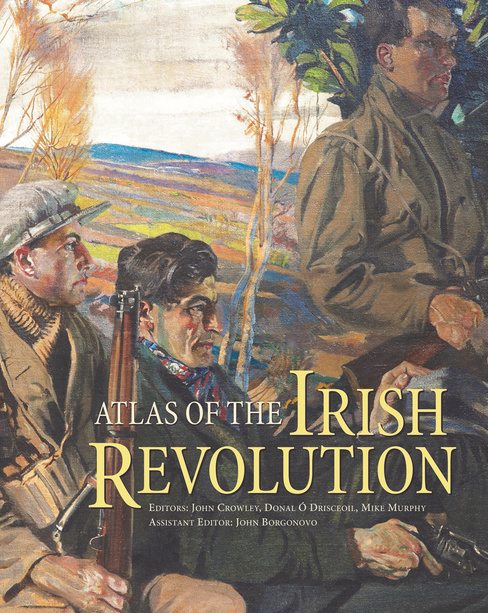
I'm delighted to have an article on the War of Independence in County Sligo in the Atlas of the Irish Revolution, just published by Cork University Press.This is a huge volume of almost 1,000 pages, written by the leading historians, geographers and literary scholars of the Irish revolutionary period.
This work, with its authoritative texts, superb photographs, informative maps and its reproduction of key documents, promises to be the outstanding publication of the ‘decade of commemoration'.
More information here.
To have a look inside the book go here.
A Sunday Business Post review here.
Thursday, July 13, 2017
Bailieborough Poetry Festival
Bailieborough Poetry Festival details online now.
A great line-up of poets from Ireland, the UK and the USA, including Noel Monahan, Patrick Chapman and Gerard Smyth, American poet Linda Opyr and Emily Wills from the UK.
The festival takes place Thursday - Saturday 5 - 7 October 2017.
Full details here: http://www.bailieboroughpoetry.com/poetry-festival/
Details of the poetry competition are also online. Judge this year is Patrick Chapman and the closing date is Friday 2 September.
http://www.bailieboroughpoetry.com/2017-poetry-prize/
Saturday, June 10, 2017
The Age of Glass - My second poetry collection
The collection contains a total of 63 poems grouped in five sections, the last of which is "Gerontology".
![]() |
| Dominic Taylor of Revival Press and myself at the launch. |
![]() |
| Nessa O'Mahony launching The Age of Glass |
I attended workshops by Nessa and Iggy and poems which developed from each workshop are included in the collection.
Michael Farry is, to use his own phrase, a poet who weaves ‘a web of mystery and belonging based on rough landmarks’. . . his gaze ranges far beyond the parochial; compassion, be it for refugees or the homeless, is a hallmark of his work. . . But he is also a poet of the domestic, and the tenderest poems celebrate family and the joys of grandparenting. The Age of Glass is a work of maturity and of wisdom. Nessa O’Mahony
A self-professed amateur archeologist - the poet as digger - Michael Farry takes a forensic look at life’s abundance, and never better than when he faces up to his own mortality; physical, then, with a dash of the metaphysical, these poems will give you pause for thought, and leave you the stronger for it! Iggy McGovern
Revival Press is a community publishing press and is the poetry imprint of The Limerick Writers' Centre. It was founded by managing editor Dominic Taylor in 2007. It has published over thirty poetry titles to date plus three anthologies including I Live in Michael Hartnett. Revival has also helped establish a number of local and national poets by publishing their first collections.
One of the aims of Revival Press is to make writing and publishing both available and accessible to all. It tries as much as possible to represent diverse voices and advocates for increased writing and publishing access to individuals and groups that have not typically had this access.
The collection, 12 euro, can be purchased from the Limerick Writers Centre website of using the PayPal link to the right.
Subscribe to:
Posts (Atom)