
I'm off to the Poetry Ireland Introductions workshop today in Dublin.
PI Introductions, that's for young upcoming poets isn't it?
Yes. No! Age doesn't come into it.
But most will be a bit, even more than a bit, younger won't they?
Maybe, I don't know. So what. It's the poetry that's important.
So you need a workshop to straighten the poetry out.
No to . . well to assist us.
So he'll take your poem and tear it to bits and everyone else will rewrite it - a committee poem.
No it will be constructive criticism in a respectful environment.
Right. So they'll tear it to bits and rewrite it.
It'll be a better poem.
But will it be yours?
Stop it. I need the help.
Indeed. So did you pick your best poem?
No I did that last week for the Don Paterson workshop and it has to be shortened by one third.
Tore to bits and rewritten! So this week?
This week it's Christ on the Ass. I like the poem but it could do with a little editing.
Dumping maybe. Who's giving the workshop?
Alan Jude Moore.
Never heard of him.
He's well known, I attended the launch of his third collection and was very impressed.
Did you buy it?
Well no. I did buy his first collection. Enjoyed it.
See!
I have limited resources and limited shelf space.
Just dump any book you've read. That's my rule.
That's enough. Where's my notepad and pencil and what's that word I learned from Don Paterson last Saturday - metonymy, metonymy - must use it .
Older and wiser indeed. That's a laugh.
Saturday, April 2, 2011

Friday, April 1, 2011
Boyne Berries 9 Launched

Another Boyne Berries launched with style and enjoyment. A good crowd, appreciative and interested. Some great reading of fine material. Noel Dempsey set the tone for the evening by saying how delighted he was to be with us and how he had feared when he launched our first issue that the magazine would not survive. He congratulated everyone involved in the magazine over the years and spoke of the quality and variety of the contents.
He said he was full of admiration for those who have the courage to express themselves and expose themselves in so many ways. He spoke of a number of individual pieces in the magazine which he had noticed in particular including Vietnam by Paddy Halligan, Peter Goulding's The Rat beneath the Shed and Paddy Smith's story The Back Seat. The Group presented him with a hefty volume, The Penguin Book of Irish Poetry, to help him pass the time in his retirement.
We then had about fourteen readers including Susan Lindsay from Galway who has just published her first volume Whispering the Secret, Steven Balbirnie from Dublin and C.P. Stewart who made the journey from North Yorkshire to read his poem And Still the Daily Gift of Days. C.P has just had his first full collection of poems Considering the Lilies published in Galway. I thought all the readings were great and that our own members excelled themselves. Well done!
Then tea and coffee and lots of chat about prose and poetry and reading aloud and Bob Dylan and Irish history and Irish poets and editing your work and publishing your work. Then someone found the usual typo in the magazine. Oh Dear!
Boyne Berries 9 can be purchased on our website, in Antonia's Bookshop and Spar Trim, and will be available in Dublin at the bookmarket in the Twisted Pepper Building on Abbey Street each Saturday afternoon from 1pm – 6pm and in Galway in Charlie Byrne's Bookshop.
Orla Fay took more photographs that I did so check out her blog for more.
Thursday, March 31, 2011
Boyne Berries Launch
 Tonight we launch Boyne Berries 9. All is in readiness. We even have the magazine, have had them for a week beforehand actually which is a record. At least twice I've collected them from the printers on the morning of the launch. Greg has done the usual great job on the black and white cover.
Noel Dempsey who recently retired is officially launching the magazine. He launched the first issue in March 2007 when he was Minister for Minister for Communications, Marine and Natural Resources so we are delighted to have him back.
We are hoping for the usual large attendance of members, locals and those who travel a distance to read their contributions and enjoy the occasion.
Wednesday, March 30, 2011
Don Paterson Workshop

The Don Paterson workshop was great. No abstract statements, everything related to a poem on a page. Don started from the premise that all the poems were good and offered ideas and comments on improvement. We joined in. This is what we do at the Boyne Writers and LitLab so I was very much at home.
Below are some of the notes I scribbled down as far as I can decipher them. All were made in the context of comments on an actual poem.
The reader should struggle with the ideas in the poem not struggle with who is who, what is the setting etc. Dramatis personae, location, chronology are easy to include, even in the title, and they help the reader engage with the poem.
It's OK to have multiple meanings but most attention must be paid to the surface meaning.
Try not to allow too many possible interpretations. Narrow the band width of interpretation by the clues you give the reader.
Concrete description sometimes lead to having too many plosive sounds in a line or stanza. Too much of this is difficult for the reader to negotiate. Words like of, the, when can often be breathing spaces in a poem. Abstract phrases usually involve fricatives. Balance both types.
Beware of too much "poetic" description. Over-kill should be avoided though a little over-kill is great. Turn down the volume a little. Avoid too much alliteration. When it barely registers it's best. Cut out superfluous words and phrases. Shorter lines often help, they force you to remove qualifiers.
The use of brackets in a poem draws attention to that which is enclosed so it better be important.
Trust the reader. Allow the reader room to read. Show the effect not the cause. Avoid informational overexplaining.
Punctuation is very important. It is the brake and accelerator in poetry. The line break itself is a form of punctuation. Too much enjambment makes the reader wonder why you used this line length at all. Don't break a wonderful phrase. The poetry line is a mnemonic phrase. Use the caesura - move it about in the line. Elizabeth Barrett Browning is an expert at this. Louis MacNeice's use of punctuation is great.
Decide on the form as early as possible. Form helps to shape the material and eliminate bad stuff.
Title. The default is -Say what the poem is about.
With some poems I don't mind that I don't understand them.
Don used the word metonymy a few times. I've heard it but never knew what it meant so it thought I'd better add it to my vocabulary. This from Wikipedia.
Metonymy is a figure of speech in which a thing or concept is not called by its own name, but by the name of something intimately associated with that thing or concept. For instance, "Westminster" is used as a metonym (an instance of metonymy) for the Parliament of the United Kingdom, because it is located there.
Metonymy may also be instructively contrasted with metaphor. Both figures involve the substitution of one term for another. In metaphor, this substitution is based on some specific similarity, whereas, in metonymy, the substitution is based on some understood association (contiguity).
Don mentioned a couple of great poems as examples in connection with particular poems which were being criticised: Anthony Hecht: More Light! More Light!; Robert Frost: Design
Tuesday, March 29, 2011
Dromineer Literary Festival 2011
 Eighth Annual Dromineer Literary Festival: Thursday 29 September ~ Sunday 2 October 2011
Full details are being finalised, but acclaimed writers Jennifer Johnston, Dermot Healy and Vincent McDonnell have confirmed that they will be taking part. Other highlights will include performances by The Poetry Divas and by The Nenagh Players, and a screening of a short film, written, directed and produced by students on the Media Arts Degree course at the Dublin Institute of Technology, Aungier St.
I've been commended twice in this competition and really enjoyed my trips to Dromineer each time. It's a friendly welcoming festival in a beautiful lakeside setting and the line up this year seems as good as ever - The Poetry Divas should shine by the lake and the setting also seems appropriate since Dermot Healy's new book length poem A Fool's Errand published last year dealt with the annual migrations of barnacle geese.
Entries for the Poetry and Short Story Competitions are now open. Poet, novelist and playwright Dermot Healy will judge the poetry competition and novelist and short story writer Vincent McDonnell will judge the short story competition.
Closing date for receipt of entries is August 19 2011. Entry Form & Rules on the website.
Monday, March 28, 2011
Boyne Berries 9 Launch
 The ninth issue of our magazine Boyne Berries will be launched on this Thursday 31 March at 8pm in the Castle Arch Hotel, Trim by recently retired Noel Dempsey. Noel, then a Government Minister, launched issue 1 of the magazine in March 2007 (picture right).
This issue has poems and prose from writers in Trim, Meath, Ireland, UK, USA, and Australia. Local writers are well represented. Anne Crinion has a poem on a memory from Trim past, Ned McManus’ Forge, Jenny Andersson writes about her Aunt Hilda, Maria Durnin writes about a shopping experience and Paddy Smith has an intriguing story called The Back Seat. Rory O’Sullivan of the Boyne Writers group has a typically dark mysterious poem called Graveland with his own evocative illustrations.
There are stories and poems about love lost and found, about childhood memories good and bad, about playing cowboys and Indians, about the past, about Vietnam, about cancer. The recent harsh winter inspired Eamon Cooke to write about the experience: A winter of extremes in keeping with the economic conditions that had recently prevailed.
A sample of some of the titles gives a hint of the variety of reading which is contained in the magazine: Inishmaan Snailbox, This Crowded Solitude Eventually, The Rat Beneath the Shed, I Took a Course in Buddhism, The Witch.
At the launch many of the contributors will attend, including one from North Yorkshire, and read their work. Admission is free and all are welcome. Previous launches have been very enjoyable occasions and have been very well attended. Boyne Berries 8 costs €8 and will be on sale at the launch, in Antonia’s Bookshop, and in SPAR Trim or can be purchased through the website. It is also available in Dublin at the bookmarket in the Twisted Pepper Building at 54 Middle Abbey Street each Saturday afternoon from 1pm – 6pm.
Sunday, March 27, 2011
dlr Poetry Now Festival
 A very busy and enjoyable day in Dun Laoghaire yesterday at the Poetry Now Festival. I met loads of poets, old friends, new friends, some we published in Boyne Berries, and probably some we rejected. Bloggers too who may have more profound thoughts on the events - Kate and Padhraig. I bought too many poetry books of course - enough to keep me reading until - well until the history book is finished.
The workshop with Don Paterson was great, very practical. Each participant read one of his/her poems, we all had copies and we by Don we criticised it. By the time we got to the end of the poems - there were 12 participants I think - we had covered everything, title, enjambment, metaphor, rhyme, line length, the reader etc etc. More later maybe on this.
Then the Irish Times Poetry Now Award presentation. The winner had been announced in the morning's Irish Times so there was no suspense. Seamus Heaney was the winner for his 12th collection, Human Chain. Three of the other four shortlisted poets were present for the presentation, Sara Berkeley, Ciarán Carson and Dermot Healy and there were apologies from Paul Muldoon. Good addresses by Gerard Smyth of the Irish Times, Brian Lynch of the judging panel and by Heaney himself who finished by reading a poem from the collection.
And then the two readings. Dave Lordan was a great started with his performance poetry which made you smile and agree when he was attacking the usual suspects but a bit uneasy and even defensive when his attach came closer to home. Fiona Sampson, editor of the Poetry Review UK, was next - a calm quiet reading which often contrasted with the subject matter. Estonian poet, Jaan Kaplinski finished this session. He told us quite a bit about his attitude to poetry, he hasn't written much/any recently because he feels he may have written enough for a lifetime and anyway there's too much poetry or too many poets. (I forget which and there is a major difference). He then started with a recent poem - one minute of silence.
The later session featured Sinead Morrissey and Gerald Stern. Sinead was for me the star of the evening. Those lovely long sinuous lines and sentences that lead you along to an unexpected place were read with great pace and confidence. She know most of her lines by heart. Gerald Stein, a US poet born in 1925 was a great performer. His introductions, anecdotes, opinions - political and otherwise - made for a most enjoyable session. And the poems were quite good as well.
Apparently this is/was the last Poetry Now in its present form. What a shame.
Saturday, March 26, 2011
dlr Poetry Now
A full day in Dun Laoghaire today at the Poetry Now Festival.
10.30: Writing workshop with Don Paterson.
1.00pm: The announcement of the winner of the seventh annual Irish Times Poetry Now Award.
This is a heavyweight Gallery Press v Faber and Faber contest. The shortlist:
Sarah Burkley - The View From Here (Gallery Books)
Ciaran Carson - Until Before After (Gallery Books)
Dermot Healy - A Fool's Errand (Gallery Books)
Seamus Heaney - Human Chain (Faber and Faber)
Paul Muldoon - Maggot (Faber and Faber)
6.30 pm Readings by Dave Lordan, Fiona Sampson & Jaan Kaplinski.
8.30 pm Readings by Gerald Stern & Sinéad Morrissey.
10.30: Writing workshop with Don Paterson.
1.00pm: The announcement of the winner of the seventh annual Irish Times Poetry Now Award.
This is a heavyweight Gallery Press v Faber and Faber contest. The shortlist:
Sarah Burkley - The View From Here (Gallery Books)
Ciaran Carson - Until Before After (Gallery Books)
Dermot Healy - A Fool's Errand (Gallery Books)
Seamus Heaney - Human Chain (Faber and Faber)
Paul Muldoon - Maggot (Faber and Faber)
6.30 pm Readings by Dave Lordan, Fiona Sampson & Jaan Kaplinski.
8.30 pm Readings by Gerald Stern & Sinéad Morrissey.
Thursday, March 24, 2011
Noel King at Boyne Reading

A very enjoyable Boyne Reading and Open Mic last evening in Trim. Our featured reader, Noel King, read from his recently published collection Prophesying the Past and held the audience's attention with his closely observed poems dealing with everyday things, looking anew at the past and the present. As chairman Paddy said, Noel King "christened" our new podium the making of which was arranged by member Anne Crinion.
A fine selection of items in the Open Mic including many from our own group, some from the Meath Writers Circle with Tommy Murray and Frank Murphy in fine form and Oran Ryan a welcome visitor from Dublin with an impressive poem.
Pictures: Top: Sarah Lundberg of Seven Towers, Orla Fay of Boyne Writers and Noel King.
Below: Tommy Murray and Noel French of Meath Heritage Centre.

Wednesday, March 23, 2011
Don Paterson Workshop Poetry Now
 The Poetry Now Festival in Dun Laoghaire is running two poetry workshops on Saturday morning 26 March. These workshops will be facilitated by poets and teachers Don Paterson and Fiona Sampson. Both workshops are aimed at poets who are building towards a first collection.
Places were limited so applicants were asked to apply by e-mailing 3 poems and a list of publications. I submitted my three poems and got an email yesterday saying I had a place on the Don Paterson workshop. I'm delighted. The poems I submitted were The British Museum Revisited Again, Clonfert and Philately. I don't know anything about the format of the workshop ot the names of other participants.
Don Paterson was born in Dundee in 1963. Since Nil Nil (1993), which won the Forward Prize for Best First Collection, he has written five collections of poetry, most recently Landing Light (2003), which won the T.S. Eliot Prize, and Rain (2009), which won the Forward Poetry Prize and the Queen’s Gold Medal for Poetry. He is also an editor, musician and dramatist, and has written English versions of works by Rilke and Machado. He teaches in the School of English at the University of St Andrews.
Tuesday, March 22, 2011
The Life and Times of a 'Gotcha'

James Linnane, one of the members of the Boyne Writers Group has just published his book, The Life and Times of a 'Gotcha'. James explains in his introduction that Gotcha was Dublin slang for a security guard used in many working class areas of the city where they worked and patrolled 24 hours a day. This book, based on actual events, tells hilarious stories from the years James worked in that trade. It's full of crazy mad events many of which were the result of boredom in what was often a mind numbing job.
We in the group have heard some of these stories in early drafts and indeed James thanks our group for their advice and criticism in the book. James is also one of the three regular readers at the weekly Knightsbridge Home poetry readings. Recently he has read from the book and his stories caused great amusement. Well done James.
James has the distinction of being a member of both of the rival writers groups in Trim, ourselves and the other one. This can bring problems when he is trying to decide which team to join for the annual Battle of the Books.
Copies of the book can be purchased from the website or directly from James at jameslinn48@gmail.com
James will be at the Noel King Boyne Readings and Open Mic this Thursday and can probably be persuaded to read a page or two of his book in the Open Mic. An added reason to attend.
Sunday, March 20, 2011
Boyne Readings and Open Mic - Noel King

This Thursday's Boyne Readings and Open Mic promised to be a special, not to be missed event. The featured reader is Noel King, writer, actor and musician, coming all the way from Tralee, Co. Kerry.
Noel's poetry, haiku, short stories, articles and reviews have appeared in publications in over thirty countries, the poetry in journals as diverse as Poetry Ireland Review, The Sunday Tribune, Studies, Bongos of the World (Japan), The Dalhousie University Review (Canada), Kotaz (South Africa), Poetry Salzburg Review (Austria) and Quadrant (Australia). Along the way he has been a singer with the famous Bunratty Castle Entertainers and has worked as an arts administrator and poetry editor.
Noel King has launched many writers through his own Doghouse Books. His book of poetry Prophesying the Past was published by Salmon last year. His poetry is a gathering together of the memories, stories and experiences that have shaped him. Often the tone is wry, melancholic, bitter even - but there is a breezy humour that occasionally bursts through. His poems are grounded in activities and people rather than in ideas.
The Readings take place in the Village Hall, Knightsbridge Retirement Village, Longwood Road, Trim and start at 8pm. As well as Noel King there will be an open mic - poetry, prose, memoir etc all welcome.
Entrance 5 euro, which includes tea/coffee and Knightsbridge home baked biscuits.
Friday, March 18, 2011
Poetry Ireland Introductions
I'm delighted to have been selected by Poetry Ireland/Éigse Éireann for the Introductions Series 2011. We received a large number of submissions for this series, so congratulations on your selection.
The Introductions Series 2011 will take place in early May (dates TBC) in the Irish Writers' Centre. A free workshop with poet Alan Jude Moore is also offered as part of the Introductions series. This workshop should be of assistance in terms of preparing both the poems and the poet for a public reading. The workshop with will run on Saturday 2nd April, 2011, 11a.m.– 4p.m.
I knew a number of those who were selected last year, Peter Goulding, Connie Roberts, Andrew Caldicott, Martin Dyar. Two of those have won the Patrick Kavanagh Poetry Competition.
The Introductions Series 2011 will take place in early May (dates TBC) in the Irish Writers' Centre. A free workshop with poet Alan Jude Moore is also offered as part of the Introductions series. This workshop should be of assistance in terms of preparing both the poems and the poet for a public reading. The workshop with will run on Saturday 2nd April, 2011, 11a.m.– 4p.m.
I knew a number of those who were selected last year, Peter Goulding, Connie Roberts, Andrew Caldicott, Martin Dyar. Two of those have won the Patrick Kavanagh Poetry Competition.
Wednesday, March 16, 2011
Happy St. Patrick's Day
 A detail from the St Patrick window in St Patrick's Church in Trim which shows St Patrick confronting the High King at Tara at Easter. This huge window is a wonderful celebration of Irish art and workmanship crammed as it is with copies of the Tara Brooch, Mediaeval Croziers, the Ardagh Chalice and many other examples of Irish metalwork from many centuries after the time of St Patrick. The designers, whoever they were, weren't worried about being anachronistic.
The window, matched on the other side by the equally fantastic Our Lady of Trim window, is like the whole church a statement of its time - the last years of the nineteenth century, the years of the Gaelic Revival and the Home Rule movement. The window is by Mayer of Munich, a world famous stained glass maker.
Monday, March 14, 2011
Bob Dylan in Cork 2011
Tickets on sale this morning for Bob Dylan in Cork in June.
But you saw him last year in Limerick!
So!
He hasn't released a new album since has he?
No but . . .
So what's the point?
Well . . .
And it's a long way to Cork.
Yes but . . .
And you're too old to stand in front of the stage
Now hold on . . .
And if you sit you'll be miles away.
I know.
And Bob doesn't allow big screens at his concerts.
Well the last time I saw him at the Marquee in Cork I did stand. Got in early and stood for hours.
You haven't been right since.
Maybe you're right.
Of course I am. Anyway he can't sing anymore, his voice is gone. It said so on the internet.
Wait a minute. What voice?
You know that mumble, mumble, mumble.
OK that settles it.
Good.
Ticketmaster? Dylan ticket. Best seated please.
But you saw him last year in Limerick!
So!
He hasn't released a new album since has he?
No but . . .
So what's the point?
Well . . .
And it's a long way to Cork.
Yes but . . .
And you're too old to stand in front of the stage
Now hold on . . .
And if you sit you'll be miles away.
I know.
And Bob doesn't allow big screens at his concerts.
Well the last time I saw him at the Marquee in Cork I did stand. Got in early and stood for hours.
You haven't been right since.
Maybe you're right.
Of course I am. Anyway he can't sing anymore, his voice is gone. It said so on the internet.
Wait a minute. What voice?
You know that mumble, mumble, mumble.
OK that settles it.
Good.
Ticketmaster? Dylan ticket. Best seated please.
Saturday, March 12, 2011
1916 Poetry
So how did the writing exercise go? I hear you ask.
you know the one where we were asked to use the first line of the Proclamation as an inspiration.
It went very well actually with everyone present having attempted it and each effort different. There were one or two which contrasted the idealism of the 1916 leaders with the state we've got ourselves and the country into. One had the lovely image of Jeremiah O'Donovan Rossa, whose funeral was an important step on the way to the Rising, stirring in his grave and another imagined a youth pausing at the GPO before getting a bus for the airport and emigration. Nothing wrong with being preachy so long as it's well done I always say.
One used the "dead generations" reference to tell us a little about an ancestor leaving us to make the possible connections and another remembered being in the dock at Kilmainham with other Irishmen and Irishwomen on a charge of no lights on the bikes.
Great stuff. Most admitted to having found it difficult and challenging and felt that the efforts needed just a bit more work.
Any mine? Well I took the historical look and reported on the races at Fairyhouse that Easter Monday as well as a few other things. Do you know who won the Irish Grand National in 1916? One stanza of my poem was:
2.40. Irish Grand National. 200 Sovereigns. Three Miles.
you know the one where we were asked to use the first line of the Proclamation as an inspiration.
It went very well actually with everyone present having attempted it and each effort different. There were one or two which contrasted the idealism of the 1916 leaders with the state we've got ourselves and the country into. One had the lovely image of Jeremiah O'Donovan Rossa, whose funeral was an important step on the way to the Rising, stirring in his grave and another imagined a youth pausing at the GPO before getting a bus for the airport and emigration. Nothing wrong with being preachy so long as it's well done I always say.
One used the "dead generations" reference to tell us a little about an ancestor leaving us to make the possible connections and another remembered being in the dock at Kilmainham with other Irishmen and Irishwomen on a charge of no lights on the bikes.
Great stuff. Most admitted to having found it difficult and challenging and felt that the efforts needed just a bit more work.
Any mine? Well I took the historical look and reported on the races at Fairyhouse that Easter Monday as well as a few other things. Do you know who won the Irish Grand National in 1916? One stanza of my poem was:
2.40. Irish Grand National. 200 Sovereigns. Three Miles.
- All Sorts 4/1
- Punch 5/1
- Ruddygore 3/1
Waterford Writers' Weekend
Waterford Writers' Weekend celebrates writing, reading and creativity. Running over three days, March 18th to 20th 2011, the lively and engaging programme is filled with workshops, readings, book signings, poetry, fiction, events for children and teens, entertainment and the long running Seán Dunne Young Writers’ Awards. The programme of events is available at www.waterfordwritersweekend.ie and you can follow us on Facebook and Twitter.
Come and listen to former Taoiseach Dr. Garret Fitzgerald, RTE’s business editor David Murphy, author and columnist Martina Devlin, poets Thomas McCarthy and Leanne O'Sullivan, authors Ed O'Loughlin, Peter Murphy and many others. Participate in writing workshops including an introduction to creative writing, writing for theatre, and learn the tricks and tips of how to get published. Over the weekend come to an Open Mic session, listen to music, attend craft exhibitions, taste the wonderful food of Waterford and so much more!
Workshops and readings can be booked at 051 849975 or by emailing writersweekend@waterfordcity.ie
The excellent promotional video is here onYouTube. Printed programmes will be available from the libraries and other venues from Wednesday 2nd March.
Come and listen to former Taoiseach Dr. Garret Fitzgerald, RTE’s business editor David Murphy, author and columnist Martina Devlin, poets Thomas McCarthy and Leanne O'Sullivan, authors Ed O'Loughlin, Peter Murphy and many others. Participate in writing workshops including an introduction to creative writing, writing for theatre, and learn the tricks and tips of how to get published. Over the weekend come to an Open Mic session, listen to music, attend craft exhibitions, taste the wonderful food of Waterford and so much more!
Workshops and readings can be booked at 051 849975 or by emailing writersweekend@waterfordcity.ie
The excellent promotional video is here onYouTube. Printed programmes will be available from the libraries and other venues from Wednesday 2nd March.
Thursday, March 10, 2011
dlr Poetry Now 2011
The programme for this year's Poetry Now Festival at Dun Laoghaire has been announced. As usual a very interesting line up. Full details on the website where you can also book tickets. If you attend the two readings on the Saturday, at 6.30 and 8.30, you'll hear Dave Lordan, Fiona Sampson, Jaan Kaplinski, Gerald Stern & Sinéad Morrissey. That's a great selection and great variety as well - Irish, north and south, UK, USA and Estonia.
There's also the Irish Times Poetry Now Award. Nominations include Muldoon, Carson, Heaney, Healy and Sara Berkeley. There's also poetry workshops by Don Paterson and Fiona Sampson.
The keynote address is by Canadian-born writer and translator, Anne Carson Her talk is entitled The Untranslatable. Speaking in Ireland for the first time, Carson will present what promises to be a characteristically hybrid and compelling exploration of a subject which she has come to know intimately through her work as a poet and classicist: translation and its difficulties, as well as untranslatability and its attractions and privileges. Carson will consider Homer, Joan of Arc, Rembrandt, Holderlin and Francis Bacon in the course of her lecture.
There's also the Irish Times Poetry Now Award. Nominations include Muldoon, Carson, Heaney, Healy and Sara Berkeley. There's also poetry workshops by Don Paterson and Fiona Sampson.
The keynote address is by Canadian-born writer and translator, Anne Carson Her talk is entitled The Untranslatable. Speaking in Ireland for the first time, Carson will present what promises to be a characteristically hybrid and compelling exploration of a subject which she has come to know intimately through her work as a poet and classicist: translation and its difficulties, as well as untranslatability and its attractions and privileges. Carson will consider Homer, Joan of Arc, Rembrandt, Holderlin and Francis Bacon in the course of her lecture.
Tuesday, March 8, 2011
A Horseman Enters a Town at Night

The Jack B Yeats show which I saw in the Model, Sligo recently includes two previously unseen paintings from the estate of the late author Graham Greene, recently sold by Christie’s of London.
The works, A Horseman Enters a Town at Night, 1948 and Man in a Room Thinking, 1947, were purchased by a private collector, who very generously made them available to The Model for the duration of Jack B Yeats -The Outsider.
Horses feature quite often in his paintings. In the early paintings they appear in his horse racing and circus pictures and in his later work horses often seem to be mysterious other worldly visitations.
Above is A Horseman Enters a Town at Night which fetched almost £350,000 when sold recently. When you look at it you can't help but think of those famous lines by his brother (written around ten years before Jack painted the picture).
Cast a cold Eye
On Life, on Death.
Horseman, pass by!
Sunday, March 6, 2011
Jack B Yeats; The Outsider

In Sligo last Friday week I went to see the new exhibition in The Model Gallery, Jack B Yeats; The Outsider which brings together forty Jack B Yeats oils from a variety of public and private collections. Many of the works included have been rarely exhibited in Ireland in the past fifty years while others have never been shown publicly before.
Curated by the internationally acclaimed artist, critic and theorist, Brian O’Doherty (aka Patrick Ireland), and Emer McGarry, Curator of The Niland Collection, the show features work spanning a sixty-year period, from an early Sligo scene completed in 1895, showing a political meeting in Sligo, to a work completed in 1956 the year before he died.
The Model is a great space to see these. Not crowded you can wander through the three or four rooms the exhibition occupies at your leisure. I love those later paintings set in some wild landscape, sometimes near the sea, sometimes a sort of imagined west of Ireland, Paul Henry shaken up, with a couple of characters, standing or walking or talking or meeting or ignoring. The catalogue speculates that Beckett, who was a friend of Yeats, may have based his two characters in Waiting for Godot on such a scene.
Above is one of these painting, The Two Travellers 1942.
The show is accompanied by a new publication with a major new critical text by Brian O’Doherty as well as new texts by Dr. Tricia Cusack and Dr. Thomas McEvilley.
The Irish Times review of the exhibition.
Saturday, March 5, 2011
1916 Poetry

Our LitLab chairman, Paddy Halligan, sent a text earlier in the week with an exercise for the next meeting. Write a story or poem, maximum 250 words, based on the first sentence of the 1916 Proclamation. Use your imagination and no questions please!
You know the sentence: IRISHMEN AND IRISHWOMEN: In the name of God and of the dead generations from which she receives her old tradition of nationhood, Ireland, through us, summons her children to her flag and strikes for her freedom.
We have done exercises in the past with great results. Variety of response is usually guaranteed though I'm always a little annoyed with members who start their contribution by saying I didn't actually follow the instructions.
Anyway I had a poem ready for the next meeting which is on Tuesday so I'm faced with this. What do I do? This kind of thing has been done, far too often:
Right proudly high in Dublin town
Hung they out a flag of war.
'Twas better to die 'neath an Irish sky
Than at Suvla or Sud el Bar.
And from the plains of Royal Meath
Strong men came hurrying through;
So what to do then? I thought What would Robert Fitterman do? Robert Fitterman. Did I ever mentioned that I heard . . . (Yes, Yes, we know - not bloody rubber ducks again!)
Anyway on Thursday after a day in the National Library and a meeting of the Boyne Writers Group I started and almost finished my 1916 poem; 258 words so I have to cut it a bit. Not bad if I say so myself.
(OK don't tell us! See if we care.)
Friday, March 4, 2011
Publishing Seminar - Irish Writers' Centre
From Inspiration to Publication, Publishing Seminar: Saturday March 12th: 10.30am-4.30pm
Novelist Emer Martin will join the Irish Writers’ Centre at 19 Parnell Square in hosting an information day on publishing that will include Literary Agent Yvonne Kinsella and Book Editor Deirdre O'Neill. The day will feature talks from industry experts and will offer the opportunity to pose questions to the speakers.
The day will commence with a talk on 'The Editorial Process' by Deirdre O'Neill, former managing editor at New Island Books (2008-2010). This will be followed by 'The Author-Agent Relationship’ by Yvonne Kinsella, Literary Agent for Prizeman & Kinsella Literary Agency. The next talk, ‘Publicising a Book from Manuscript to Paperback’, will be given by Helen Gleed O'Connor, Literary Publicist for Gill Hess Ltd (clients include Random House, Transworld, Simon & Schuster and Faber & Faber).
After lunch, Fiction Buyer for Eason's Stephen Boylan will discuss 'Book Trends and the Marketplace'. The final talk will be 'Sustaining a Writer's Life' from Emer Martin.
Registration is from 10.30am; tickets are €60 for non-members, €50 for members and must be booked in advance by paying online or calling the Centre.
Contacts: Clodagh Moynan and Kerrie O'Brien, Tel: +353 1 8721302. email: info@writerscentre.ie
Novelist Emer Martin will join the Irish Writers’ Centre at 19 Parnell Square in hosting an information day on publishing that will include Literary Agent Yvonne Kinsella and Book Editor Deirdre O'Neill. The day will feature talks from industry experts and will offer the opportunity to pose questions to the speakers.
The day will commence with a talk on 'The Editorial Process' by Deirdre O'Neill, former managing editor at New Island Books (2008-2010). This will be followed by 'The Author-Agent Relationship’ by Yvonne Kinsella, Literary Agent for Prizeman & Kinsella Literary Agency. The next talk, ‘Publicising a Book from Manuscript to Paperback’, will be given by Helen Gleed O'Connor, Literary Publicist for Gill Hess Ltd (clients include Random House, Transworld, Simon & Schuster and Faber & Faber).
After lunch, Fiction Buyer for Eason's Stephen Boylan will discuss 'Book Trends and the Marketplace'. The final talk will be 'Sustaining a Writer's Life' from Emer Martin.
Registration is from 10.30am; tickets are €60 for non-members, €50 for members and must be booked in advance by paying online or calling the Centre.
Contacts: Clodagh Moynan and Kerrie O'Brien, Tel: +353 1 8721302. email: info@writerscentre.ie
Wednesday, March 2, 2011
Cricket: Ireland beat England

A great victory in the Cricket World Cup! After a loss to Bangladesh Ireland bounce back with a victory over England. Not easily won. On a good batting pitch England batted first and made 327. Irish bowlers did well especially in restricting England towards the end when it looked like 350 was possible. It did appear that the asking total was too much, the Irish batting has often been the weakest element. I watched all the English innings and the start of the Irish.
The commentators tried not to be condescending but now and then referred to this being a useful exercise for England after their draw against India at the week-end. They were however fulsome in their praise for the Irish at the end.
Irish captain William Porterfield was out first ball and it looked like the fight was for a respectable total. Off I went to read poetry in the Knightsbridge Retirement Home.
Perhaps an omen was that one of our resident readers read Arthur Hugh Clough's
Say not the struggle naught availeth,
The labour and the wounds are vain,
The enemy faints not, nor faileth,
And as things have been they remain.
When I came home I turned on the TV expecting to see "experts" praising Ireland for a courageous display, another gallant defeat but no the match is still on, and Ireland need 35 runs from 30 balls to win. Kevin O'Brien has come in and made 100 runs from 50 balls, the quickest century in World Cup history. They keep calm and win in the last over. Great celebrations! This is the greatest run chase in World Cup history.
The Irish team has Ed Joyce playing, back after a spell playing for England. Irishman Eoin Morgan isn't playing for England because he is injured. This is an All-Ireland team their flag is not the tricolour. Captain Porterfield has a Northern Irish accent and O'Brien a Dublin accent.
RTE report. Telegraph report. BBC report.
Tuesday, March 1, 2011
World Book Day
 Thursday 3 March is World Book Day. Hadn't heard that until yesterday so nothing planned by the Boyne Writers. We do have a regular meeting on that evening though.
The Irish Writers' Centre, Dublin is marking the day with events from 12 noon to 9pm. All the day’s events there are free and all are welcome to attend.
The celebrations will kick off at 12pm with a free Inkslingers creative writing session led by Andrew McEneff. This is a structured hour where participants will be given a series of writing prompts.
This will be followed at 1pm with Lunchtime Poetry Readings where celebrated poets, recent winner of the Michael Hartnett Prize Peter Sirr, Gerald Dawe, Paul Perry, 2011 winner of the Arvon Poetry Prize Jean O' Brien, Richard Halperin and Aifric Mac Aodha, read from their latest collections. Jean O'Brien awarded me a prize at the Goldsmith Festival a couple of years ago. I heard Richard Halperin read at Goldsmith and at iYeats in Sligo last year where he and I were commended.
At 3pm the Irish Writers' Centre will launch a new series of Madaptations with a film screening of James Joyce's The Dead. The Madaptations series will be held once a month at the Centre and will showcase films that have been based on books.
The celebrations will conclude at 7pm with a dramatic performance of Patrick Kavanagh's The Great Hunger performed by Peter Duffy. With echoes of the Great Famine in the title and in the text, the poem focuses on the life and struggles of the anti-hero and small farmer Patrick Maguire. I saw this or part of it at the Patrick Kavanagh Week-end in Inniskeen last year. Very impressive.
A great line-up and all free!
Sunday, February 27, 2011
Suze Rotolo has died

Susan Elizabeth Rotolo (1943- 2011), who has just died was best known as Suze Rotolo the woman walking with Bob Dylan on the cover of his album The Freewheelin' Bob Dylan. She was his Dylan's girlfriend between 1961 and 1964. In 2008 she published a memoir, A Freewheelin' Time: A Memoir of Greenwich Village in the Sixties, describing her time with Dylan and other figures in the folk music scene in Greenwich Village, New York.
Rotolo became an artist specialising in artists' books and taught at the Parsons School of Design in New York City.
A number of Dylan's songs are regarded as having been written for or to Suze. Boots of Spanish Leather supposedly was written after she left New York to study in Italy. This song has been included in the Popular Ballads of the 20th Century section of the Norton Anthology of Poetry, 5th edition.
The last time Bob played this song live was at the Echo Arena, Liverpool on May 1, 2009. I was there, that was the night he played George Harrison's Something to mark his first visit to the city since George's death.
I got a letter on a lonesome day
It was from her ship a-sailin’
Saying I don’t know when I’ll be comin’ back again
It depends on how I’m a-feelin’
Saturday, February 26, 2011
Sligo Elections 1918, 2011.
 My talk at the Sligo Field Club went reasonably well last evening. A good crowd, knowledgeable, interested, very good questions afterwards - some of which I didn't know the answer to. The Field Club treat their invited speakers very well!
When you have a script with which you are reasonably familiar the temptation is to wander a bit from it. This can get you into trouble with your Powerpoint display which depends on following the script. Anyway I managed to get from 1914 to 1918 without too many detours.
Interesting on the drive down to pass through the various constituencies as marked by the posters. Sligo itself full of posters, lots of candidates especially on the left with various splits on the labour side. Interesting to mention that the 1918 election was the last parliamentary election without PR in the country and to speculate on the fact that Sinn Féin would not have won the landslide they did if the system had been PR.
Someone remarked on RTE today that but for PR Fianna Fáil would end up with hardly any seats after this election.
I met a couple of people who had interesting stories and indeed what sounds like very interesting pictures from the period. Great for the new book.
On the way back today I listened to Ocean FM for the first part with detailed coverage of the Sligo-North Leitrim tally, then to RTE and nearer home to LMFM for the West and East Meath counts. History being made!
Before leaving Sligo I found the sad neglected grave of the the last MP for South Sligo, John O'Dowd, defeated in 1918, and indeed physically assaulted during the campaign. He's buried in the graveyard just outside his native Bunninadden. How fickle the voting public can be.
Friday, February 25, 2011
Gone to Sligo
A busy day. Voted early in Trim. Go on tell us!
Set the television to record the Cricket World Cup game, Ireland's first, against Bangladesh. Cricket is a great game to record. By using fast forward you can watch every bit of the action in a fraction of the time.
Then on the road to Sligo. One call to someone who might have something useful for the new history book then on to Sligo town. City!.
Hope to see the new Jack B Yeats exhibition in the Model Art. I remember seeing the Yeats centenary exhibition in the National Gallery in 1971. I bet he still has the catalogue.
Then something to eat and on the Sligo Education Centre for the Sligo Field Club lecture. Talk.
The Sligo Weekender called me an "eminent historian". Oh dear! No stopping him now.
Set the television to record the Cricket World Cup game, Ireland's first, against Bangladesh. Cricket is a great game to record. By using fast forward you can watch every bit of the action in a fraction of the time.
Then on the road to Sligo. One call to someone who might have something useful for the new history book then on to Sligo town. City!.
Hope to see the new Jack B Yeats exhibition in the Model Art. I remember seeing the Yeats centenary exhibition in the National Gallery in 1971. I bet he still has the catalogue.
Then something to eat and on the Sligo Education Centre for the Sligo Field Club lecture. Talk.
The Sligo Weekender called me an "eminent historian". Oh dear! No stopping him now.
Wednesday, February 23, 2011
Sligo 1914-1918
 I was delighted to be asked to give a talk to the Sligo Field Club. The club was founded in 1945 and is much more than a local history society. Their interests include archaeology, history including industrial, architectural and engineering history, folklore, botany, ornithology and geology.
I suggested the title: From Irish Parliamentary Party to Sinn Féin; County Sligo 1914-1918 and it will be delivered on this Friday, 25 February, at 8pm in the Sligo Education Centre, Institute of Technology Campus, Sligo.
I'm looking forward to the event but there's a little anxiety also. Speaking to Sligo people, many of whom have an interest and knowledge in the period, is a challenge. I hope to learn something myself, clarity on some of the grey areas, more photographs, who knows.
That change in the politics of the country from 1914 to 1918 is very interesting and it is a nice coincidence that what promises to be an historic election is taking place on the same day.
Tuesday, February 22, 2011
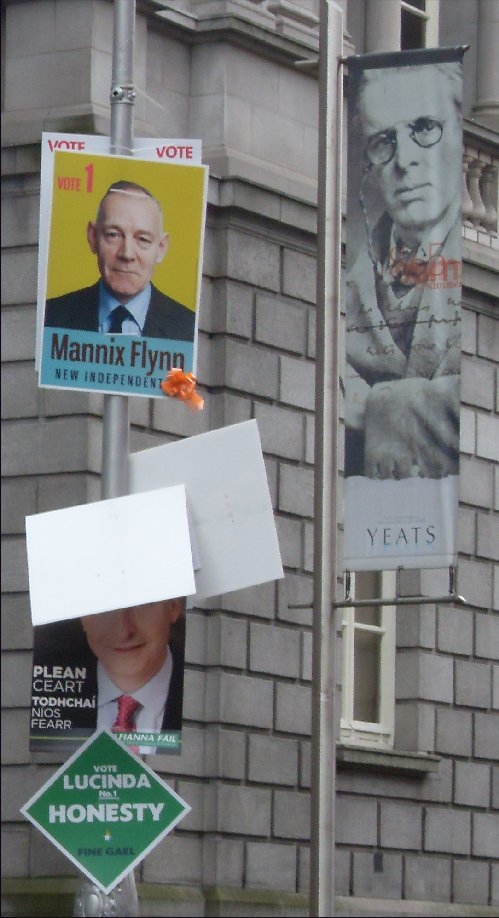
General Election Posters
 I'm not one of those who thinks that election posters deface our towns and countryside. I welcome this brief outburst of colour and smiles especially this year when it has happened so early after such a hard winter - something to do with global warming maybe. A hundred lamp posts in Trim have bloomed. Well maybe not a hundred. Is it just me or are there fewer posters than usual?
Bright idea for a summer festival - have a poster competition and put the short listed ones on lamp posts around the town and let the public vote for their favourites. Could even be short poems on the posters. Must keep that idea to myself in case someone steals it. What? Upstart?
Anyway there must be a list of dos and don't for poster-putter-uppers. Surely the Fianna Fáil party has told theirs not to put up posters of their new leader near closed down or unopened business premises. You can make up your own jokes and puns on the fact that Emerald Jewellers here in Haggard St, Trim has closed. (Emerald Isle etc) I should in fairness point out that the shop on the extreme left is actually open and trading.
Note: The inclusion of an image or remark in relation to the forthcoming election in Ireland (Republic of) in this blog is not intended either as an indication of the way the present writer intends to vote nor is it in any way designed to influence readers in the exercise of their franchise.
Monday, February 21, 2011
The World of Women

The Sligo Times 1913 had a regular feature The World of Women which occupied almost a half a page. Full of what you might expect, of its time. I presume it was a syndicated column, bought in from the UK. I haven't read it in any detail but I see no particular Irish slant. Conducted by Violette Deschamps, whoever she was. Nothing on the internet as far as I can find.
The paper did cover the suffragette campaign in Sligo in 1913. There was a Sligo Branch of the Irish Women’s Suffrage Federation and they held open air meetings at Rosses Point during the summer months on Wednesday afternoons - half day in Sligo I suppose. These were often well attended and the speakers included English suffragette Miss Kineton Parkes and Dora Mellone from (what is now) Northern Ireland. Miss Alice Abadam, a UK suffragette, spoke at a meeting in Sligo Town Hall in 1913
The organiser of the Sligo branch appears to have been Olga Crichton from Carrowgarry, Beltra west of Sligo town. She was married to local landowner Alexander Crichton. He was very involved in the music scene in sligo at the time. An internet search reveals that her maiden name was Olga Bestujeff Bieneman, born circa 1864. She was the daughter of Johannes Bieneman of Brighton. She married in 1884 and died in 1948.
The suffrage campaign in Sligo and indeed in much of the UK ceased with the outbreak of war in 1914. Two of Olga's sons took part in the war, her eldest, 29 year old Alexander Godfrey Crichton, died at the Dardenelles in August 1915.
My father's people were from the Beltra area and I have a feeling that he and/or some of his brothers worked for the Crichtons at some stage. If so they must have met Olga.
All this is fascinating and a great example of how you get sidetracked when researching newspapers. At best the Sligo suffragettes will get a paragraph in my Irish Revolution book. Now when that's finished - well there's the book on silent movies in Sligo 1909-1929 and then . . . . . .
Saturday, February 19, 2011
Short Story Masterclass
The Irish Writers Centre is offering twelve lucky short story writers a free Masterclass and a chance to use a writing space in the Irish Writers' Centre for the month of March.
John MacKenna will lead a discussion on the short-story - from garnering ideas to plotting the story; from the development of character to the setting of landscape. The session will focus on the discipline necessary to create and complete a piece of short fiction - how to forget the extreme ironing and concentrate on the writing. Through questions and answers and the sharing of experiences, the seminar will be a practical help in starting and finishing work. The masterclass will take place on Friday 4th March from 2-5pm.
John MacKenna is the author of fourteen books - including four collections of short stories.
To apply simply e-mail the opening paragraph of a short story on any theme (max 150 words) to info@writerscentre.ie along with a brief cover letter. The subject of the e-mail should be 'The Long and the Short of It'. No attachments please - all text should be in the body of the e-mail. The deadline is Monday February 28th at 12pm.
John MacKenna will lead a discussion on the short-story - from garnering ideas to plotting the story; from the development of character to the setting of landscape. The session will focus on the discipline necessary to create and complete a piece of short fiction - how to forget the extreme ironing and concentrate on the writing. Through questions and answers and the sharing of experiences, the seminar will be a practical help in starting and finishing work. The masterclass will take place on Friday 4th March from 2-5pm.
John MacKenna is the author of fourteen books - including four collections of short stories.
To apply simply e-mail the opening paragraph of a short story on any theme (max 150 words) to info@writerscentre.ie along with a brief cover letter. The subject of the e-mail should be 'The Long and the Short of It'. No attachments please - all text should be in the body of the e-mail. The deadline is Monday February 28th at 12pm.
Friday, February 18, 2011
Boyne Readings : Small Impact Group

A great Boyne Reading and Open mic last evening, one of the biggest attendances for some time. Our featured readers were the Small Impact Writers Group from Navan led by Edel Gillick. The six members who read treated us to a wonderful selection mostly from their recent publication Hidden Depths.
We had a romantic story set in central Europe with a Faustian connection, a story about King Puck in Kerry, a robin poem, a story about an Australian visit and the wonderful Niall's Story which describes a father and special son playing football. Edel Gillick read from her children's book The Boy Who Fell down the Well.
Pictured above: The small Impact Group, from left: James Byrne, Sean Reilly, Edel Gillick, Michael Sheils, Anne Ritter, Pat McConnon.
Thursday, February 17, 2011
Long Listed
I've cut down on poetry competition entries this year but here's a bit of good(ish) news from one I entered earlier. This is the Cinnamon Press Poetry Collection Award. The money prize is small but the winner does get a volume of poetry published. Not me, but I did get on the long list. I see Kate Dempsey's name there also - well done!
I had to check my competitions spreadsheet to see what I had entered - ten random poems I thought might impress, not any kind of sequence. The results and lists are not on the website yet as far as I can see.
We are finally delighted to announce that the winner of the £100 prize and contract for the publication of her first collection is Louise Warren, whose collection, A Child’s Last Picture Book of the Zoo, will be published in July 2012. All short-listed poets together with those in the narrowed down long-list will have work in the winners’ anthology. This will be a combined anthology also featuring the winners of the short story competition: A Roof of Red Tiles & other stories & poems will be published in April 2011 and all entrants will receive a copy.
I had to check my competitions spreadsheet to see what I had entered - ten random poems I thought might impress, not any kind of sequence. The results and lists are not on the website yet as far as I can see.
We are finally delighted to announce that the winner of the £100 prize and contract for the publication of her first collection is Louise Warren, whose collection, A Child’s Last Picture Book of the Zoo, will be published in July 2012. All short-listed poets together with those in the narrowed down long-list will have work in the winners’ anthology. This will be a combined anthology also featuring the winners of the short story competition: A Roof of Red Tiles & other stories & poems will be published in April 2011 and all entrants will receive a copy.
Wednesday, February 16, 2011
Boyne Readings and Open Mic - February
A writers’ group based in Navan will be the featured readers at the February Boyne Readings and Open Mic in Trim tomorrow (Thursday) evening.
“This is the first time we have invited a group,” said Paddy Smith, chairman of the Boyne Writers Group, which organises the monthly readings on the third Thursday of each month. The readings take place in the Village Hall of the Knightsbridge Retirement Home, Longwood Road, Trim, starting at 8pm.
“We don’t expect the Small Impact Writers’ Group to live up to their name,” said Paddy. “Not because they’re from Navan but because they have been making a big impact, from what we hear. "This is their first visit to Trim as a group and we expect very big things from them,” he said.
The Navan group recently published its first collection of short stories and poems, entitled ‘Hidden Depths’. At the Trim event, members of the group will take it in turn to read their own material and other members’ work, both from this publication and from their other writings.
In the open mic session after the featured readings, visiting writers and members of the host Boyne Writers Group will read their own work – poetry, prose and plays – for the entertainment of those present.
Visitors are particularly welcome, whether they wish to read or not. The €5 admission includes tea/coffee and biscuits.
Tuesday, February 15, 2011
No Bouquets For This

I was saddened first and then annoyed to see the notice above in a local branch of a continental chain store advertising its Valentine's Day bunches of roses.
What exactly is the message? Something like - Men are tight-fisted cheapskates who wouldn't buy a girl a bunch of roses unless there were cheap. An example of sex stereotyping, gender insulting, belittling nasty advertisement which should attract as much condemnation as sneering at female football officials or calling Mexicans typically lazy rightly did recently.
Part of Section 2.17 of the the Advertising Standards Authority for Ireland Code states: "Marketing communications should respect the principle of the equality of men and women. They should avoid sex stereotyping and any exploitation or demeaning of men and women."
Complaints can easily and quickly be made on the ASAI website.
Monday, February 14, 2011
Love Poems

OK if you're still looking for a love poem for the day that's in it you may find something to suit your situation on this page from Poets.org. Notice the Irishmen there in Traditional & Classic Love Poems? Yes Yeats is there with When you are old but so is Meath-born John Boyle O'Reilly (1844-1890) with The White Rose.
Sunday, February 13, 2011
From the Manger to the Cross
 Back to Sligo 1913. From the Manger to the Cross was a very early feature film, was made in 1912, released in the UK in October 1912 and shown in Sligo the following Lent 1913. More info here.
There were two dedicated cinemas in the town and films were also shown in the Town Hall and in the Gillooley Hall where this was shown. These silent films weren't silent of course, there was a band or orchestra playing along. In this case note that sacred music was being played.
The Sligo Times reported great interest in the film with the Catholic Bishop of Elphin attending and saying he was very impressed. It also stressed that people of all faiths attended.
How much was the entry charge in modern terms? Well the local newspaper cost 1 penny and the cheapest seats were six times that, most expensive twenty four times that. Multiply the cost of your local paper by those figures. The UK National Archives have a money converter here. According to that those expensive two shilling seats are the equivalent of five pounds sterling 71 cents.
Friday, February 11, 2011
Crocus

We have no snowdrops in our garden. I keep meaning to plant them but forget. Remind me next October please. That means that the crocus is usually our first spring flower and sure enough in the past week they have appeared here and there. They come up in places I had forgotten about including in this corner of the enclosed rose and willow garden. Well it will be a rose and willow garden if the roses I pruned a bit too severely last year recover.
I tidied this up last year, it was one of the two project which had to be done in the garden. Yes that is a bicycle built into the rose bush trellis - it once belonged to my mother, then we had it and rather than dump it when it became too old I put it in there. A talking point.
Crocus poems are few. The Crocus, a poem by Harriet Beecher Stowe here.
Emily Dickinson was very fond of gardening especially of corms and bulbs. Here is a stanza of hers from this page:
The feet of people walking home
With gayer sandals go -
The crocus - till she rises -
The vassal of the snow -
The lips at Hallelujah
Long years of practise bore -
Till bye and bye, these Bargemen
Walked - singing - on the shore.
Thursday, February 10, 2011
The Sligo Times

It's quite an experience, to read a full years supply of a newspaper in one day. The Sligo Times for 1913 is an interesting paper, too interesting in some ways. I continually had to stop myself reading the bits which had no relevance to what I was looking for. I was particularly taken with the amount of entertainment available in Sligo at the time, concerts, drama, variety, opera, orchestral societies, card games etc. There were three cinemas at the time in the town - this was still the age of silent movies. This deserves a study sometime. Not now.
The Sligo Times was a short lived "Conservative" newspaper edited by Robert Smyllie, a Scotsman who moved to Sligo. He was the father of the Robert Smyllie who was a famous editor of the Irish times later. Conservative meant Unionist, anti-Home Rule but he was also trying to make a financial success of the paper so the Unionism is muted. He does report on Unionists meetings in Sligo and has some editorials criticism of the Home Rule movement and the Liberal/Irish Party coalition.
The paper is a bright breezy affair with a farmers section, a women's column, a chess feature and lots of local, national and international news. Plenty of sensationalism as well, gruesome murder and accident stories taken from English papers. In spite of this the paper was not a financial success and collapsed in February 1914. Smyllie left Sligo for Belfast and worked on a Belfast newspaper.
Tuesday, February 8, 2011
I'm Voting for W. B. Yeats
I'm voting for Yeats - Best poster by far.
So what did he say about the recession. Well maybe this-
Part V in the sequence Nineteen Hundred and Nineteen from The Tower.
I like the last stanza especially, all would-be stand-up comedians take note, we traffic in mockery indeed.
Come let us mock at the great
That had such burdens on the mind
And toiled so hard and late
To leave some monument behind,
Nor thought of the levelling wind.
Come let us mock at the wise;
With all those calendars whereon
They fixed old aching eyes,
They never saw how seasons run,
And now but gape at the sun.
Come let us mock at the good
That fancied goodness might be gay,
And sick of solitude
Might proclaim a holiday:
Wind shrieked - and where are they?
Mock mockers after that
That would not lift a hand maybe
To help good, wise or great
To bar that foul storm out, for we
Traffic in mockery.
So what did he say about the recession. Well maybe this-
Part V in the sequence Nineteen Hundred and Nineteen from The Tower.
I like the last stanza especially, all would-be stand-up comedians take note, we traffic in mockery indeed.
Come let us mock at the great
That had such burdens on the mind
And toiled so hard and late
To leave some monument behind,
Nor thought of the levelling wind.
Come let us mock at the wise;
With all those calendars whereon
They fixed old aching eyes,
They never saw how seasons run,
And now but gape at the sun.
Come let us mock at the good
That fancied goodness might be gay,
And sick of solitude
Might proclaim a holiday:
Wind shrieked - and where are they?
Mock mockers after that
That would not lift a hand maybe
To help good, wise or great
To bar that foul storm out, for we
Traffic in mockery.
Monday, February 7, 2011
The Irish Revolution 1912-1923: Sligo

No going back now. Some details of my book are on the Four Courts Press website here, publication date winter of 2012. 15.75 euro paperback and 40.50 euro hardback. Still far from finished but I hope to make the deadline of November 2011.
My volume on Sligo, along with Tyrone by Fergal McClusky, will the first of The Irish Revolution, 1912-23 Series (Mary Ann Lyons & Daithí Ó Corráin, series editors).
I'm on the 1920-21 period at the moment. Very difficult because of all that has been written on this period recently and the amount of information available but it will be done. Then back to the 1912-1915 period. I do have a plan but it's not a chronological one. I actually started with the end, the civil war section since that's what I know most about. Today researching The Sligo Times 1913 in the National Library.
No cover design either on the website but then I'm supposed to come up with some photographs for the books, photographs that haven't been used yet preferably. I presume they'll use something from these for the cover. I do have a few photographs but not enough yet. Anyone got relevant photographs from Co Sligo for the period 1912-1923 preferably unpublished?
Saturday, February 5, 2011
Boyne Writers Group AGM

Extracts from the Chairman, Paddy Smith’s Address to the AGM of Boyne Writers, 3rd February, 2011.
We have a nice little group here and I’m proud to be chairman of it.
Among other things, I’m fascinated by the dynamics of our group – comprising people who by definition are very individualistic and wouldn’t be expected to be ‘group’ people.
I’m struck by the respectful manner in which we criticise each other’s works. Not easy to walk that thin line. I think we all abide by the practice, as someone said in relation to criticism: never use a knife to cut when you can use a spoon.
Arab proverb: Insults should be written in the sand, and praises carved in stone. And if I ever get a word of praise in this group, I look forward to carving it in stone!
Some more apt quotations:
Norman Vincent Peale: The trouble with most of us is that we would rather be ruined by praise than saved by criticism.
Noel Coward: I love criticism just so long as it's unqualified praise.
Looking back at the year, the most remarkable development in this group has been the emergence and growth of so many writers of prose. At any given meeting, the prose writers match the poets in numbers if they don’t outnumber them. This in itself is worth remarking on. Within this category we have also seen the emergence and development of writers of memoir. And I think it’s fair to say that the work of these people has grown in quality as well as quantity over the year.
Having said all that, the poets continue to be the thoroughbreds of the group. And this is borne out by the rosettes of various colours that they have won during the year. Congratulations to all.
I think we’re learning from each other, in better writing of course, but not least in the method of criticism, and it’s great to see the performance of the different members in their criticisms of other people’s works. On the other hand, we would like to continue to stamp out the practice of members apologising for their work in advance, before they’ve even read it. Out with that sort of thing! Out! Out! Out! On the other hand, it’s always interesting to hear a member’s own thoughts on his or her work – after it has been read and after it has been criticised by others. A member’s own thoughts often bring an entirely new dimension to the piece of work.
Hopefully in this coming year we can win back the Battle of the Books trophy from our arch friends, the Meath Writers Circle.
In conclusion, to all members, I wish the writing equivalent of ‘tight lines’ in fishing – which I presume is ‘loose, free-flowing lines’ or something. And, in particular, to our poets, I say: keep it up, this could be the year.
Picture above: The new officers of the group, Barbara, Michael, Orla and Paddy.
Friday, February 4, 2011
Boyne Writers Group Annual Report
After a number of postponements because of the weather we finally had our 2010 AGM last evening. This a short version of the annual report.
Boyne Writers Group has had another very successful year with increased membership and increased attendance at fortnightly meetings.
Two issues of our magazine Boyne Berries, 7 and 8, have been published during 2010. Boyne Berries 7 was launched in March 2010 by Meath county Librarian Ciaran Mangan and Boyne Berries 8 was launched in September by Noel French of the Meath Heritage Centre. Issues 9 and 10 will be published in 2011. We hope to make issue 10 a special issue and would welcome suggestions as to content or format.
The group started the Boyne Readings and Open Mic in 2009 and this has proved a success. Readers in 2010 were: February: Susan Connolly. March: Ross Hattaway and Oran Ryan. April: Kate Dempsey. May: Willie Hodgins. October: Emer Davis. November: Grainne Toher. December: Kieran Furey. We are very grateful to Knightsbridge Village for allowing us use The Village Hall.
Once again we played a significant role in the Trim Swift Festival. We again organised the Satire Competition. The prizes totalling 1000 euro were given by the Trim Swift Festival Committee. This year’s judge was John Murray of RTE.
We also took part in the second Battle of the Books satire competition which was part of the Swift Festival. Our team of Barbara Flood, Caroline Finn, James Linnane and Michael Farry was narrowly defeated by the Meath Writers Circle team. Congratulations to the victors and thanks to all our members who took part and those who supported the team. We thank the Trim Swift Festival committee for their generous contribution towards the Group’s ongoing work.
We organised a poetry reading in the Church of Ireland cathedral, Trim for All Ireland Poetry Day 2010.
Members of our group were invited to read at Readings and Open Mics in Dublin and Drogheda. Four members read at a session organised by the Viaduct Bards in Drogheda and two members read at a Last Wednesday event in Westmoreland St organised by Seven Towers.
Three Boyne Writers Group members read poetry to residents of Knightsbridge Retirement Village each Wednesday and this has proven a great success. In 2010 the group was invited to organise events in Knightsbridge for the annual Bealtaine Festival which celebrates creativity in older age. The group was also invited to be part of the Positive Ageing Week and they organised an event in Knightsbridge which involved them reading some of their work designed to spark memories and discussion. Two members also read poetry every second Friday in St Joseph’s Nursing Home, Trim.
Congratulations to all of our members who enjoyed success in having their work published in newspapers and magazines, were commended or were prize winners in competitions.
A special thanks goes to the Castle Arch Hotel, Trim who accommodate us in the lounge every second Thursday night and host our launches. Thanks especially to our members who make each meeting a special occasion and who continue not only to write but to have the courage to read it to the rest of us and put up with the ensuing criticism. Well done!
Boyne Writers Group has had another very successful year with increased membership and increased attendance at fortnightly meetings.
Two issues of our magazine Boyne Berries, 7 and 8, have been published during 2010. Boyne Berries 7 was launched in March 2010 by Meath county Librarian Ciaran Mangan and Boyne Berries 8 was launched in September by Noel French of the Meath Heritage Centre. Issues 9 and 10 will be published in 2011. We hope to make issue 10 a special issue and would welcome suggestions as to content or format.
The group started the Boyne Readings and Open Mic in 2009 and this has proved a success. Readers in 2010 were: February: Susan Connolly. March: Ross Hattaway and Oran Ryan. April: Kate Dempsey. May: Willie Hodgins. October: Emer Davis. November: Grainne Toher. December: Kieran Furey. We are very grateful to Knightsbridge Village for allowing us use The Village Hall.
Once again we played a significant role in the Trim Swift Festival. We again organised the Satire Competition. The prizes totalling 1000 euro were given by the Trim Swift Festival Committee. This year’s judge was John Murray of RTE.
We also took part in the second Battle of the Books satire competition which was part of the Swift Festival. Our team of Barbara Flood, Caroline Finn, James Linnane and Michael Farry was narrowly defeated by the Meath Writers Circle team. Congratulations to the victors and thanks to all our members who took part and those who supported the team. We thank the Trim Swift Festival committee for their generous contribution towards the Group’s ongoing work.
We organised a poetry reading in the Church of Ireland cathedral, Trim for All Ireland Poetry Day 2010.
Members of our group were invited to read at Readings and Open Mics in Dublin and Drogheda. Four members read at a session organised by the Viaduct Bards in Drogheda and two members read at a Last Wednesday event in Westmoreland St organised by Seven Towers.
Three Boyne Writers Group members read poetry to residents of Knightsbridge Retirement Village each Wednesday and this has proven a great success. In 2010 the group was invited to organise events in Knightsbridge for the annual Bealtaine Festival which celebrates creativity in older age. The group was also invited to be part of the Positive Ageing Week and they organised an event in Knightsbridge which involved them reading some of their work designed to spark memories and discussion. Two members also read poetry every second Friday in St Joseph’s Nursing Home, Trim.
Congratulations to all of our members who enjoyed success in having their work published in newspapers and magazines, were commended or were prize winners in competitions.
A special thanks goes to the Castle Arch Hotel, Trim who accommodate us in the lounge every second Thursday night and host our launches. Thanks especially to our members who make each meeting a special occasion and who continue not only to write but to have the courage to read it to the rest of us and put up with the ensuing criticism. Well done!
Wednesday, February 2, 2011
It's Spring - No it's not
It's official, it's Spring.
No it's not. Where's the sunshine and daffodills?
But yesterday was February 1st, start of Spring.
There's no official "start" of spring.
There must be, like December or January.
No, spring isn't a month. It's a season.
Yes I know that. So when does it start?
It doen't just "start" on a particular day. It's a process. you know when people say - spring was late this year. It's to do with growth and warmth of the earth and so on.
So what date does Spring start on?
Ahhhhhhhhh.
So yesterday was just a random day, no significance.
Not exactly, it was the feast of St Brigid one of the patron saints of Ireland.
Ah yes she the one who was once a pagan goddess and then turned into a Christian.
I don't think it was actually like that.
But there was a Celtic godess called Brid or something like that?
Probably not, just a made up invention of medieval myth makers.
And this Celtic Spring festival of Imbolx or something like that - I saw it on the internet.
The same invented rubbish probably, made up a thousand years afterwards.
Well at least yesterday was the first of February, you can't dispute that.
Well there is the matter of the eleven days lost in 1752.
Ah yes but that was a change enacted by a government.
An alien colonial government. An undemocratically elected government. Hardly any men and only a handful of women could vote at the time. Hardly a legitimate procedure.
So yesterday should have been . . . . the twelfth of February!! Why don't you give up that history writing and go back to poetry! All these facts and figure are having a bad effect on you. More fancy free composition is what you need!
Indeed. Your opinion is noted.
And by the way spring is normally not written with a capital letter.
No it's not. Where's the sunshine and daffodills?
But yesterday was February 1st, start of Spring.
There's no official "start" of spring.
There must be, like December or January.
No, spring isn't a month. It's a season.
Yes I know that. So when does it start?
It doen't just "start" on a particular day. It's a process. you know when people say - spring was late this year. It's to do with growth and warmth of the earth and so on.
So what date does Spring start on?
Ahhhhhhhhh.
So yesterday was just a random day, no significance.
Not exactly, it was the feast of St Brigid one of the patron saints of Ireland.
Ah yes she the one who was once a pagan goddess and then turned into a Christian.
I don't think it was actually like that.
But there was a Celtic godess called Brid or something like that?
Probably not, just a made up invention of medieval myth makers.
And this Celtic Spring festival of Imbolx or something like that - I saw it on the internet.
The same invented rubbish probably, made up a thousand years afterwards.
Well at least yesterday was the first of February, you can't dispute that.
Well there is the matter of the eleven days lost in 1752.
Ah yes but that was a change enacted by a government.
An alien colonial government. An undemocratically elected government. Hardly any men and only a handful of women could vote at the time. Hardly a legitimate procedure.
So yesterday should have been . . . . the twelfth of February!! Why don't you give up that history writing and go back to poetry! All these facts and figure are having a bad effect on you. More fancy free composition is what you need!
Indeed. Your opinion is noted.
And by the way spring is normally not written with a capital letter.
Tuesday, February 1, 2011
The Bureau of Military History
The Bureau of Military History was established in January 1947 'to assemble and co-ordinate material to form the basis for the compilation of the history of the movement for Independence from the formation of the Irish Volunteers on 25th November 1913, to the 11th July 1921.' It contains 1773 witness statements, 334 sets of contemporary documents, 42 photographs and 12 voice recordings.
The Bureau of Military History collection was closed to the public until recently and when I was writing history we were continually complaining about this. It is now open to the public and I've seen the statements from Sligo participants. They are somewhat disappointing, in general short, carefully composed, lacking detail. Most finish with the Truce so no Civil War details are included.
On the other hand it's great that someone decided to collect these statements and they provide a very good basis for writing a history of the period. These statements are available in the Military Archives, copies are in the National Archives. The index is available online and pdfs of particular statements will be emailed by the Military Archives on request.
Even more useful are the interviews the famous Republican activist and writer Ernie O'Malley carried out with survivors in the early 50s. These are preserved in the UCD Archives. The main problem with them is O'Malley's handwriting, very difficult to decipher.
The Bureau of Military History collection was closed to the public until recently and when I was writing history we were continually complaining about this. It is now open to the public and I've seen the statements from Sligo participants. They are somewhat disappointing, in general short, carefully composed, lacking detail. Most finish with the Truce so no Civil War details are included.
On the other hand it's great that someone decided to collect these statements and they provide a very good basis for writing a history of the period. These statements are available in the Military Archives, copies are in the National Archives. The index is available online and pdfs of particular statements will be emailed by the Military Archives on request.
Even more useful are the interviews the famous Republican activist and writer Ernie O'Malley carried out with survivors in the early 50s. These are preserved in the UCD Archives. The main problem with them is O'Malley's handwriting, very difficult to decipher.
Subscribe to:
Posts (Atom)


 Posts
Posts


